Why PHP Still Powers the Web in 2025
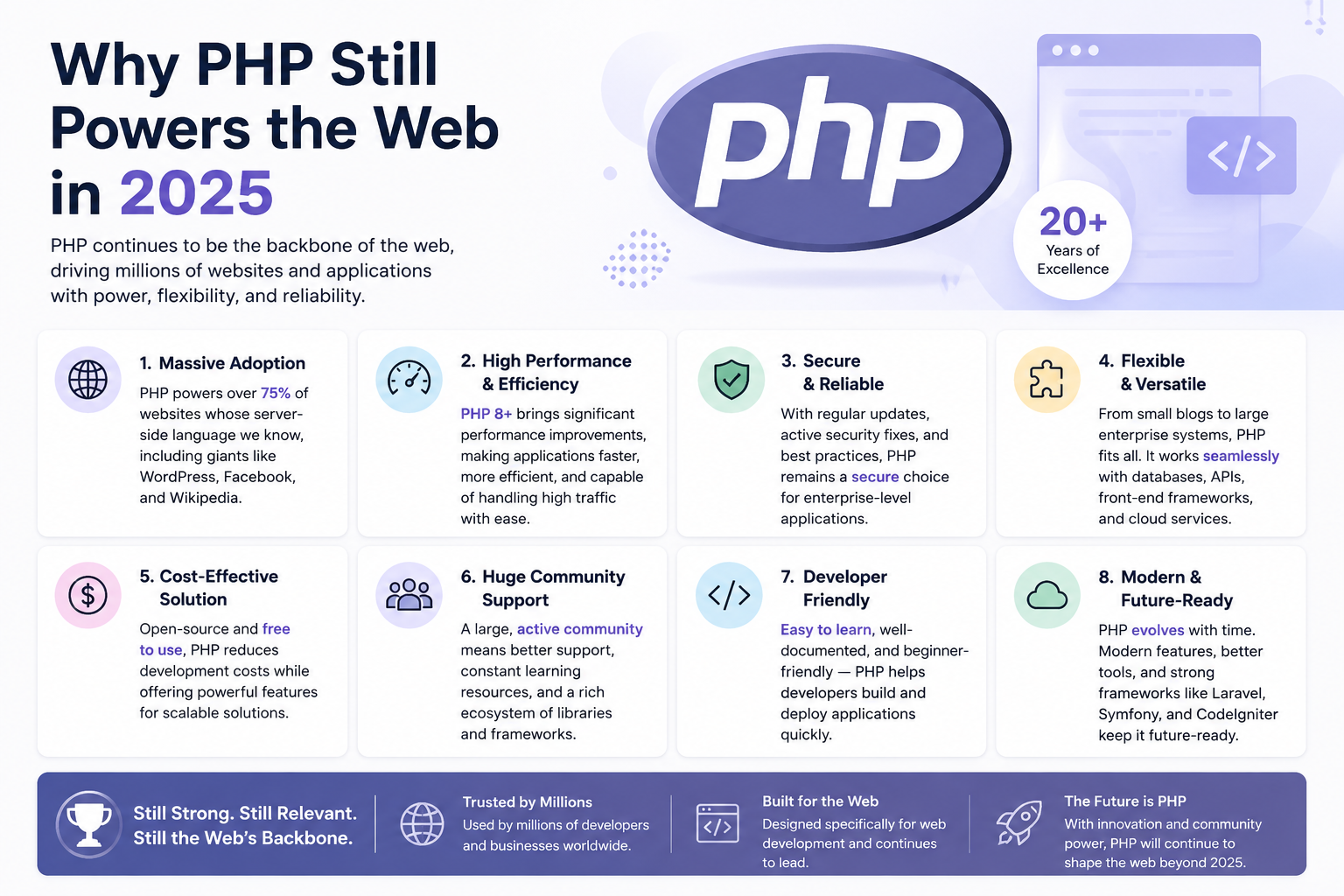
In a world dominated by modern programming languages and frameworks, PHP continues to hold its ground as a major force in web development. Despite the rise of technologies like Node.js, Python, and Go, PHP remains one of the most widely used languages for building dynamic websites and applications. As of 2025, it still powers a significant portion of the web, including platforms like WordPress, Drupal, Joomla, and Laravel-based systems. The question that often arises is simple yet fascinating: why does PHP still dominate the web after nearly three decades
The answer lies in a combination of history, adaptability, ecosystem maturity, and the continuous evolution of the language. Let us explore the reasons behind PHP’s enduring dominance in 2025 and why it remains a favorite among developers and businesses alike.
The Historical Significance of PHP
PHP, which stands for Hypertext Preprocessor, began its journey in 1995 as a simple scripting tool for managing personal web pages. Created by Rasmus Lerdorf, it quickly evolved into a powerful server-side language that made web development more accessible. During the late 1990s and early 2000s, PHP became the backbone of the internet’s explosive growth.
This period saw the emergence of popular platforms such as WordPress, phpBB, and Joomla, all powered by PHP. These platforms allowed individuals and organizations to easily create and manage websites without deep programming knowledge. By the time alternatives like Python or Ruby started gaining traction, PHP had already built a massive ecosystem and developer base.
The Evolution of PHP Over the Years
One of the key reasons for PHP’s longevity is its constant evolution. The language has gone through several major transformations that have kept it relevant and modern.
PHP 5 Revolution
PHP 5 introduced object-oriented programming (OOP), bringing structure and scalability to the language. It also improved error handling, XML support, and performance. This version made PHP suitable for larger and more complex applications.
PHP 7 Performance Leap
PHP 7, released in 2015, was a game-changer. It introduced the Zend Engine 3.0, which significantly boosted execution speed and reduced memory usage. Many websites saw performance improvements of up to 200% just by upgrading to PHP 7.
PHP 8 and Beyond
PHP 8 and its later versions introduced Just-In-Time (JIT) compilation, union types, attributes, and named arguments, further enhancing developer productivity and code clarity. In 2025, PHP 8.3 continues to offer state-of-the-art features comparable to modern programming languages.
PHP’s Massive Ecosystem
One of PHP’s biggest strengths lies in its ecosystem. The availability of frameworks, content management systems, and libraries makes development faster and more efficient.
Popular Frameworks
Frameworks like Laravel, Symfony, CodeIgniter, and CakePHP have brought modern development principles such as MVC architecture, routing, and ORM integration into PHP. Among them, Laravel has become the go-to framework for modern web applications, offering elegant syntax, built-in authentication, and robust community support.
Content Management Systems (CMS)
Platforms like WordPress, Drupal, and Joomla continue to dominate the CMS market. WordPress alone powers over 40% of all websites, and its foundation is entirely PHP-based. This ensures that PHP remains a vital part of the internet ecosystem.
Cost Efficiency and Accessibility
PHP is open source and free to use, which has always been a major advantage for startups and small to medium-sized businesses. It runs seamlessly on inexpensive shared hosting environments and works perfectly with the LAMP stack (Linux, Apache, MySQL, PHP).
Unlike some newer technologies that require specialized environments or costly infrastructure, PHP applications can be deployed almost anywhere. Its compatibility with popular databases and servers makes it highly adaptable for diverse business needs.
The Developer Community and Support
Another key reason PHP thrives in 2025 is its vast and supportive developer community. There are millions of PHP developers worldwide contributing to open-source projects, plugins, libraries, and frameworks.
Learning resources are abundant, from tutorials and online courses to community forums and official documentation. The constant feedback loop between the community and PHP’s core developers ensures continuous improvement and innovation.
PHP and Modern Web Trends
Contrary to misconceptions, PHP is far from outdated. It has evolved to support modern web development trends, including APIs, microservices, and serverless architectures.
Integration with APIs
PHP easily integrates with RESTful and GraphQL APIs, allowing developers to create fast, scalable, and flexible applications.
Support for Modern Frontend Frameworks
PHP plays well with frontend technologies like React, Vue.js, and Angular. Many developers use PHP as a backend API provider for single-page applications (SPAs).
Cloud and Serverless Compatibility
With the rise of cloud computing, PHP now runs smoothly on major platforms such as AWS Lambda, Google Cloud Functions, and Azure Functions, allowing developers to build serverless applications efficiently.
PHP’s Security and Reliability
Security is often cited as a concern in web development, but PHP has made significant strides in this area. The core language now includes built-in functions for password hashing, input sanitization, and data encryption. Frameworks like Laravel and Symfony add another layer of protection through CSRF tokens, prepared statements, and secure session handling.
In addition, PHP has a proven track record of powering large-scale, mission-critical applications. Many enterprises continue to rely on PHP for its stability and backward compatibility.
The Business Perspective
From a business standpoint, PHP offers several compelling advantages. It reduces time to market, lowers development costs, and ensures access to a large talent pool. The ability to quickly find developers familiar with PHP and its frameworks makes maintenance and scaling much easier.
Furthermore, PHP’s compatibility with existing legacy systems means businesses do not have to completely rebuild their infrastructure when upgrading. This long-term reliability contributes to PHP’s continued dominance in web development.
Comparison with Other Languages
While new languages like Python, JavaScript (Node.js), and Go have gained popularity, PHP continues to excel in its domain.
PHP vs Python
Python is excellent for AI, data science, and automation, but PHP outperforms it in the web development ecosystem due to its native web server integration and CMS dominance.
PHP vs Node.js
Node.js offers a non-blocking I/O model and is ideal for real-time applications. However, PHP provides simpler deployment, better hosting support, and more stable frameworks for traditional web development.
PHP vs Ruby
Ruby on Rails was once a strong competitor, but its community has declined over the years. PHP’s larger community and consistent updates have helped it maintain relevance.
The Future of PHP
As we move deeper into the era of AI, automation, and cloud computing, PHP continues to evolve to meet new challenges. The upcoming versions of PHP are expected to enhance performance, improve syntax, and expand support for asynchronous programming.
The continued success of Laravel, WordPress, and emerging PHP-based SaaS platforms ensures that the language remains integral to the web ecosystem. Moreover, PHP’s adaptability means it will likely coexist with newer technologies rather than being replaced by them.
Conclusion
PHP’s endurance is no accident. It is a result of consistent evolution, strong community support, a vast ecosystem, and unparalleled accessibility. In 2025, PHP continues to power millions of websites, from small blogs to enterprise-level applications.
While newer languages may dominate in specialized areas, PHP remains the undisputed workhorse of the web. Its simplicity, flexibility, and reliability make it an irreplaceable part of the digital landscape.
As long as the web exists, PHP will continue to play a vital role in shaping its foundation, proving that innovation does not always mean abandoning the old — sometimes, it means perfecting it.


