Using PHP for Microservices in 2025
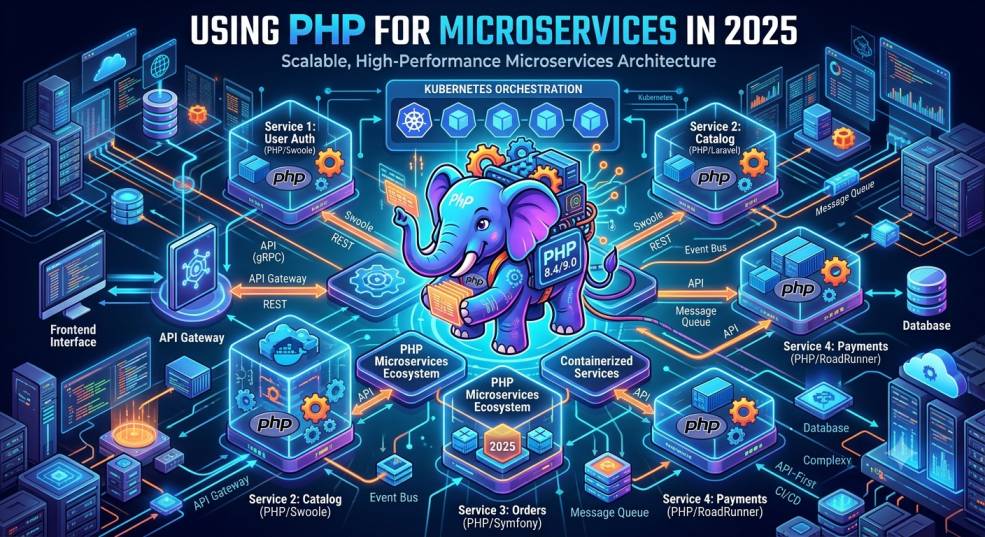
As modern web applications become more complex, developers are shifting from traditional monolithic architectures to microservices-based systems. Microservices allow teams to build scalable, independent, and maintainable components that communicate seamlessly with one another. While PHP has long been associated with monolithic web apps, its evolution—especially with frameworks like Laravel, Symfony, and Slim—has made it a viable choice for building microservices in 2025.
This article explores how PHP fits into the microservices ecosystem, why it remains a strong contender for distributed systems, and how developers can leverage modern PHP tools to build high-performance microservices that stand the test of time.
What Are Microservices?
Microservices are small, independent services that focus on performing one specific function. Instead of a single codebase handling all business logic, each service in a microservices architecture runs as a separate process and communicates with others through lightweight protocols like HTTP, gRPC, or message queues.
Key Characteristics of Microservices
-
Independently deployable: Each service can be updated or scaled without affecting others.
-
Loosely coupled: Services interact through APIs rather than direct dependencies.
-
Focused responsibilities: Every service serves a single business function.
-
Technology agnostic: Different microservices can be written in different programming languages.
In short, microservices architecture encourages flexibility, modularity, and fault tolerance—three critical traits for modern web systems.
Why Use PHP for Microservices in 2025?
Despite PHP’s legacy roots, the language has matured significantly. PHP 8 and 8.3 introduced performance boosts, asynchronous capabilities, and better error handling, making it a suitable choice for microservice development. Here’s why PHP remains relevant in this architecture:
1. Mature Ecosystem and Frameworks
Modern PHP frameworks such as Laravel, Symfony, Slim, and Lumen provide robust tools for building RESTful APIs, handling requests, and managing routing efficiently—perfect for microservice-based applications.
2. Performance Improvements
With JIT compilation and OPcache, PHP 8+ delivers near-native performance, drastically reducing response times. Combined with technologies like Swoole, PHP now supports asynchronous I/O, enabling developers to build non-blocking, high-throughput services.
3. Easy Integration
Microservices often interact with external APIs or databases. PHP’s rich library ecosystem and built-in extensions make integration seamless with REST, GraphQL, or gRPC endpoints.
4. Scalability and Containerization
Using Docker and Kubernetes, PHP services can be containerized and deployed independently, ensuring smooth scalability. This aligns perfectly with microservice design principles.
5. Familiarity and Talent Pool
PHP remains one of the most popular server-side languages, with a massive developer community. Teams can adopt a microservices approach without needing to switch languages or retrain.
Setting Up a PHP Microservice Architecture
Let’s explore how to structure PHP-based microservices efficiently.
Step 1: Define Clear Service Boundaries
Each microservice should handle one business domain. For example, an e-commerce platform could have:
-
User Service (authentication, registration)
-
Product Service (inventory, catalog management)
-
Order Service (purchase and delivery)
-
Payment Service (transactions, refunds)
Step 2: Choose a Lightweight Framework
Use a minimal PHP framework to keep microservices fast and lean. Slim Framework and Lumen are excellent choices for RESTful APIs.
Example setup with Slim:
Step 3: Use Docker for Isolation
Each microservice should run in its own container. A simple Dockerfile might look like this:
Then use Docker Compose to manage multiple services and databases effortlessly.
Step 4: Communication Between Services
Microservices communicate via REST APIs, message brokers, or queues. PHP integrates well with tools like RabbitMQ, Kafka, or Redis for asynchronous messaging.
Example communication flow:
-
Order Service sends a message to a RabbitMQ queue after a new order is placed.
-
Payment Service listens to that queue and processes the payment.
Step 5: Database per Service
Each service should manage its own database to avoid tight coupling. For example, the Product service may use MySQL, while the Payment service might use MongoDB.
Step 6: Centralized API Gateway
An API gateway acts as the single entry point for clients. It routes incoming requests to the correct microservice, manages load balancing, authentication, and rate limiting.
Tools like Kong, Traefik, or NGINX can serve as gateways for PHP-based microservices.
Handling Security in PHP Microservices
Security is a top concern in distributed systems. Implementing secure communication and data protection is crucial.
1. Use HTTPS for All Communication
Every service should use TLS/SSL to encrypt data in transit.
2. Token-Based Authentication
Use JWT (JSON Web Tokens) or OAuth 2.0 for user authentication and service-to-service authorization.
3. Validate Input Rigorously
Each microservice should validate incoming requests and sanitize data to prevent attacks like SQL injection or XSS.
4. Implement Rate Limiting
Use middleware or API gateways to restrict excessive requests and prevent DDoS attacks.
Monitoring and Logging
Distributed systems can become difficult to debug. Implement centralized logging and monitoring to maintain visibility.
-
Use Monolog or Graylog for structured logging.
-
Track API performance using Prometheus or Grafana.
-
Apply distributed tracing with OpenTelemetry to track requests across multiple services.
Deploying PHP Microservices
Using Docker and Kubernetes
Each PHP microservice runs as an independent Docker container, and Kubernetes handles orchestration, scaling, and rolling updates.
Continuous Integration/Continuous Deployment (CI/CD)
Automate build and deployment using GitHub Actions, GitLab CI, or Jenkins. Each service should have its own pipeline for testing and deployment.
Example CI/CD Flow
-
Developer commits code changes.
-
PHPUnit tests are executed automatically.
-
Docker image is built and pushed to a registry.
-
Kubernetes deploys the updated service automatically.
This ensures consistency and reliability across deployments.
Performance Optimization Tips
-
Use OPcache to speed up PHP execution.
-
Cache responses using Redis or Memcached.
-
Minimize dependencies to reduce image size and response time.
-
Adopt async PHP with libraries like Swoole for real-time performance.
-
Batch requests or use message queues for heavy workloads.
Advantages of PHP Microservices
-
Faster development and easier debugging.
-
Independent scaling—only high-demand services need more resources.
-
Flexibility to mix PHP with other languages like Python or Go for specific services.
-
Resilience—failure in one service doesn’t bring down the entire application.
-
Easier testing and continuous delivery.
Challenges and How to Overcome Them
-
Increased Complexity: Use orchestration tools like Kubernetes to simplify management.
-
Data Consistency: Adopt eventual consistency with message queues.
-
Network Latency: Optimize internal APIs and enable caching.
-
Monitoring Overhead: Use unified logging systems and distributed tracing tools.
Real-World Use Cases
Many leading companies use PHP for microservices-based systems:
-
Slack uses PHP for backend API layers.
-
Etsy and Mailchimp use PHP microservices for user management and analytics.
-
Laravel Vapor leverages PHP’s serverless capabilities to deploy microservices on AWS Lambda.
These examples prove that PHP remains a capable player in cloud-native and distributed architectures.
Conclusion
As we step into 2025, PHP continues to evolve beyond its monolithic past. With the rise of lightweight frameworks, containerization, and asynchronous programming, PHP has become a powerful tool for building efficient, scalable, and reliable microservices.
By combining the simplicity of PHP with modern DevOps practices—like Docker, Kubernetes, and CI/CD—you can design systems that are both flexible and future-proof.
Microservices with PHP allow developers to deliver features faster, scale seamlessly, and maintain independence across teams. The key is to embrace clean architecture, automation, and observability.
So, whether you’re modernizing an old monolith or starting fresh, PHP is ready to power your microservices journey in 2025 and beyond.


