Salesforce Marketing Cloud: AI Use Cases
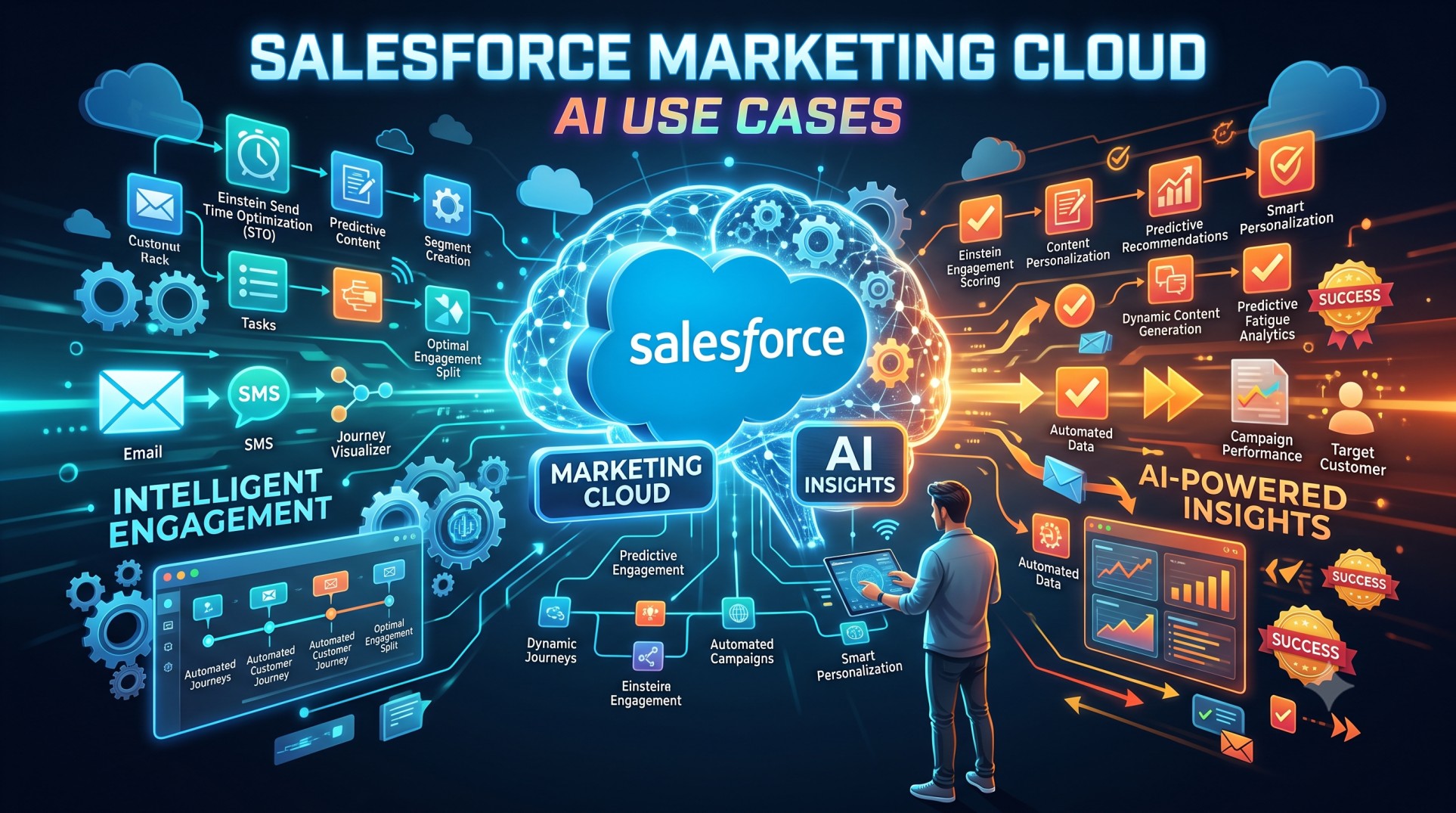
In today’s fast-moving digital era, marketing is no longer just about broadcasting messages to the widest possible audience. Customers expect brands to know them, understand their preferences, and deliver highly personalized experiences. Salesforce Marketing Cloud (SFMC), powered by Einstein AI, helps businesses transform traditional marketing into smart, automated, and data-driven engagement. From personalized campaigns to predictive analytics, AI enables marketers to optimize customer journeys, increase conversions, and reduce operational costs.
In this comprehensive guide, we’ll explore the top AI use cases in Salesforce Marketing Cloud and how businesses can leverage them to stay ahead of the competition.
Understanding Salesforce Marketing Cloud & Einstein AI
Salesforce Marketing Cloud is a cloud-based platform that provides tools for:
-
Email marketing
-
Journey orchestration
-
Social media advertising
-
Audience segmentation
-
Personalization
-
Analytics and reporting
Einstein AI integrates deeply with these modules to automate decision-making, analyze behavior, and predict outcomes. Instead of raw data, marketers now receive actionable insights.
Top AI Use Cases in Salesforce Marketing Cloud
1. Predictive Email Engagement
Email remains one of the most powerful marketing channels, but engagement fatigue is common. Einstein AI predicts:
-
Best time to send emails
-
Likelihood of opens and clicks
-
Unsubscribe risk
Using Einstein Send Time Optimization, marketers can schedule campaigns when each recipient is most likely to engage. This boosts:
-
Open rates
-
Click-through rates (CTR)
-
Conversion metrics
Real-world example:
An eCommerce brand saw a 23% increase in CTR after optimizing send times using Einstein.
2. Personalized Customer Journeys
Customer behavior changes constantly. AI observes their interactions across:
-
Websites
-
Apps
-
Email campaigns
-
Social ads
Using Journey Builder, Einstein recommends personalized next steps:
-
Send an offer email if user abandons cart
-
Offer free shipping after multiple product views
-
Trigger loyalty rewards after repeat purchases
The result:
Better retention and higher lifetime value (LTV).
3. Predictive Scoring for Leads and Customers
Not every prospect is ready to buy. Einstein uses historical and behavioral data to score users based on:
-
Purchase intent
-
Engagement potential
-
Churn risk
Sales teams can now focus on high-value leads instead of guessing.
Key outcomes:
-
Reduced acquisition cost (CAC)
-
Higher conversion rates
-
Shorter sales cycles
4. AI-Driven Content Recommendations
Content marketing often struggles with relevancy. Einstein analyzes browsing history, demographics, and purchase patterns to recommend:
-
Blog topics
-
Product suggestions
-
Dynamic email content
For example:
-
Tech enthusiasts receive gadget-focused newsletters
-
Fitness users receive workout gear recommendations
This dynamic personalization significantly boosts engagement.
5. AI-Powered Audience Segmentation
Traditional segmentation uses static rules such as age, gender, or location. Einstein AI improves this by:
-
Identifying hidden behavioral patterns
-
Grouping customers dynamically
-
Updating segments automatically
Marketers no longer need manual segmentation—AI continuously analyzes customer evolution.
6. Social Media Sentiment Analysis
Einstein AI monitors social channels and analyzes:
-
Emotional tone
-
Brand perception
-
Complaint trends
-
Positive feedback loops
If sentiment drops, teams can respond quickly with engagement strategies. This helps protect brand reputation in real-time.
7. Predictive Churn Detection
One of the biggest marketing challenges is customer churn—losing paying users. Einstein predicts:
-
Who is likely to churn
-
Why they may churn
-
When churn risk increases
Marketers can automatically trigger:
-
Discount codes
-
Loyalty offers
-
VIP experiences
This dramatically reduces churn rates.
8. Ad Spend Optimization
Digital ad budgets often get wasted due to broad targeting. Einstein optimizes ads by:
-
Identifying highest-converting audience segments
-
Allocating budget intelligently
-
Predicting ROI before spending
This ensures maximum return for every dollar spent.
9. Automated Customer Service & Chatbots
AI-powered bots integrated with Marketing Cloud and Service Cloud can:
-
Answer queries instantly
-
Suggest relevant products
-
Recommend troubleshooting steps
-
Route complex issues to support staff
The result:
Better customer satisfaction without added labor cost.
Why AI-Driven Marketing Matters
AI in Salesforce Marketing Cloud provides strategic benefits:
Improved Personalization
Customers feel seen, understood, and valued.
Higher Engagement
Relevant content → higher CTR and conversions.
Reduced Marketing Costs
Smart targeting eliminates unnecessary campaigns.
Better Decision-Making
AI converts big data into meaningful insights.
Industries Benefiting from Salesforce Marketing Cloud AI
E-commerce
-
Automated product recommendations
-
Abandoned cart recovery
Healthcare
-
Patient outreach automation
-
Personalized appointment reminders
Finance
-
Fraud prediction
-
Investment recommendation journeys
Travel & Hospitality
-
Trip-based offers
-
Churn-risk traveler notification
Best Practices for Implementing AI in Marketing Cloud
1. Start with Clean Data
Poor data produces weak predictions. Ensure:
-
Accurate contact information
-
Proper tagging
-
Updated preferences
2. Train Your Team
Marketers need to understand:
-
Einstein dashboards
-
Journey Builder AI nodes
-
Segmentation models
3. Measure Performance
Track improvements in:
-
CTR
-
Retention
-
Sales conversions
4. Experiment Frequently
Test variations in:
-
Content
-
Offers
-
Channels
AI works best with iterative learning.
Common Mistakes to Avoid
-
Over-automation without human oversight
-
Ignoring data compliance (GDPR, HIPAA)
-
Using too many complex journeys at once
-
Relying on outdated segmentation lists
Moderation and strategy are key.
Future of AI in Salesforce Marketing Cloud
Over the next 3–5 years, expect advancements like:
Hyper-personalization
One-to-one dynamic webpages based on real-time behavior.
Predictive Journey Optimization
AI automatically selects customer paths with highest conversion probability.
Voice-Based Marketing
Integrations with smart assistants like Alexa and Siri.
AI-generated campaign assets
Automated copywriting, subject line suggestions, and image creation.
Conclusion
Salesforce Marketing Cloud’s AI capabilities are transforming the marketing landscape. With predictive insights, automated personalization, and intelligent segmentation, businesses can increase ROI, build loyalty, and deliver memorable customer experiences.
Brands that adopt AI today will become tomorrow’s leaders in customer engagement.
Whether you are an SMB or enterprise, Einstein AI in Salesforce Marketing Cloud empowers your team to work smarter—not harder.


