PHP Dependency Injection Simplified
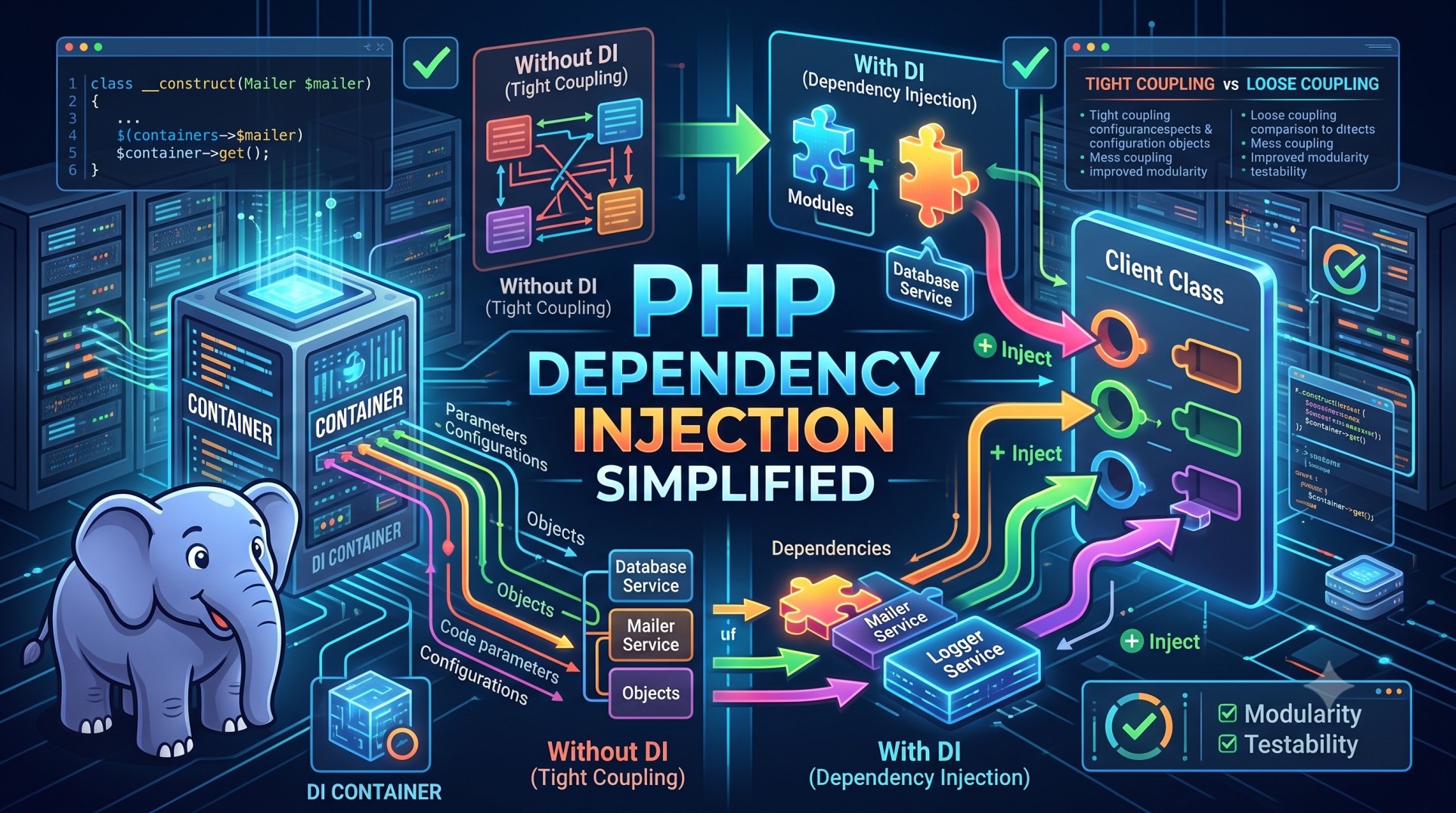
In modern PHP development, writing clean, modular, and maintainable code is essential. One of the best ways to achieve this is through Dependency Injection (DI) — a design pattern that helps reduce tight coupling and makes your code easier to test and scale. Although it may sound technical, dependency injection is actually a simple and powerful concept once you grasp the basics.
What Is Dependency Injection?
Dependency Injection is a way of providing an object with the tools or services it needs, rather than having it create them internally. In simpler terms, it means giving an object its dependencies instead of letting it build them itself.
For example, if a UserController needs to use a UserService, instead of creating it inside the controller, we inject it from the outside. This makes the controller flexible and independent of how the service is implemented.
By doing this, if you ever need to switch out UserService for another implementation (for example, one that uses a different database), you don’t need to rewrite the controller — you just inject a new version of the service.
Why Dependency Injection Matters
1. Improves Testability
When dependencies are injected, they can easily be replaced with mock or fake objects during testing. This makes your unit tests more reliable and independent of external systems like databases or APIs.
2. Increases Reusability
Because classes don’t create their dependencies directly, they can be reused in other parts of the application without modification.
3. Enhances Maintainability
If a dependency changes, you don’t need to modify every class that uses it — you only update the injected instance. This makes long-term maintenance much easier.
4. Supports Loose Coupling
Loose coupling allows your components to evolve independently, enabling cleaner architecture and easier scaling as your application grows.
Types of Dependency Injection
Constructor Injection
This is the most common form. Dependencies are passed through the class constructor. It ensures that an object has everything it needs right when it’s created.
Setter Injection
Dependencies are provided using setter methods after the object has been created. This approach allows for optional dependencies but can lead to inconsistent states if not managed properly.
Interface Injection
This method involves injecting dependencies through an interface. It’s less common but sometimes useful in large systems that rely heavily on abstractions.
Dependency Injection in Modern PHP Frameworks
Laravel
Laravel’s service container automatically resolves dependencies through reflection. When you type-hint a class in your controller or service constructor, Laravel automatically injects the right object.
For example, if you write a controller that depends on UserService, Laravel’s container automatically creates and injects that service without you having to manually instantiate it.
Symfony
Symfony’s Dependency Injection component is one of the most powerful and configurable systems in the PHP ecosystem. It allows you to define services and their dependencies in configuration files or through annotations, providing fine-grained control over how dependencies are managed.
Slim and Lumen
Lightweight frameworks like Slim and Lumen use containers like Pimple to handle dependency management in a simple, fast way. This keeps your microservices or APIs lean while still supporting DI.
Common Mistakes Developers Make with DI
-
Over-Injection – Injecting too many dependencies into one class often indicates poor design. Each class should focus on a single responsibility.
-
Ignoring the Container – Many developers still manually create dependencies in frameworks that already provide automatic resolution. This defeats the purpose of DI.
-
Injecting Concrete Classes – Always inject interfaces instead of concrete classes. This makes swapping implementations easier.
-
Skipping DI in Small Projects – Even in small projects, using DI ensures better scalability and maintainability as your codebase grows.
Best Practices for Effective Dependency Injection
-
Use Interfaces: Depend on abstractions, not concrete classes.
-
Keep Constructors Clean: Avoid overloading constructors with too many dependencies.
-
Leverage the Framework’s Container: Use Laravel’s or Symfony’s built-in containers instead of creating your own.
-
Combine with Design Patterns: Dependency injection works well with patterns like Repository, Strategy, and Factory.
-
Use Autowiring: Modern frameworks support automatic dependency resolution, which minimizes boilerplate code.
Benefits of Dependency Injection
-
Promotes clean architecture and separation of concerns.
-
Makes code easier to test, mock, and extend.
-
Reduces duplication and improves readability.
-
Increases scalability for large enterprise-level projects.
-
Simplifies long-term maintenance and reduces technical debt.
Real-World Example
Imagine you’re building an eCommerce system. A PaymentController needs both an OrderService and a PaymentGateway. Instead of creating them inside the controller, you inject them:
When you need to switch from one payment gateway (e.g., PayPal) to another (e.g., Stripe), you don’t need to modify the controller at all. You just inject a different gateway implementation. This flexibility makes your codebase adaptable to future changes without rewriting logic.
Dependency Injection vs Service Locator
It’s easy to confuse Dependency Injection with the Service Locator pattern. However, they are quite different. With DI, dependencies are explicitly provided to a class, while with a Service Locator, a class retrieves its dependencies from a central registry.
While Service Locator can seem simpler at first, Dependency Injection is generally preferred because it makes dependencies explicit and improves transparency in your code.
When Should You Use Dependency Injection?
Dependency Injection is especially useful when:
-
You’re working on large applications with multiple modules.
-
You need to easily test your code using mocks or stubs.
-
You plan to switch implementations (e.g., different APIs or services).
-
You want to follow SOLID principles and ensure modularity.
However, for very small scripts or one-off utilities, DI might be overkill. Use it where it provides clear architectural benefits.
Advantages for Enterprise PHP Applications
In enterprise environments, DI ensures that services like logging, caching, and database access are consistent across the entire application. It allows developers to configure and modify dependencies in one central place without affecting the rest of the codebase.
With the increasing adoption of microservices and containerized architectures, dependency injection also plays a major role in making PHP services more maintainable and portable across different environments.
Conclusion
Dependency Injection is more than just a design pattern — it’s a philosophy of writing clean, modular, and testable PHP code. It helps reduce coupling, enhances maintainability, and prepares your application for future growth.
In 2025 and beyond, frameworks like Laravel, Symfony, and Slim make DI easier than ever, ensuring PHP applications remain scalable and developer-friendly. By embracing dependency injection today, you’re not just simplifying your code — you’re future-proofing your entire architecture for the evolving world of web development.


