PHP and GraphQL: Getting Started
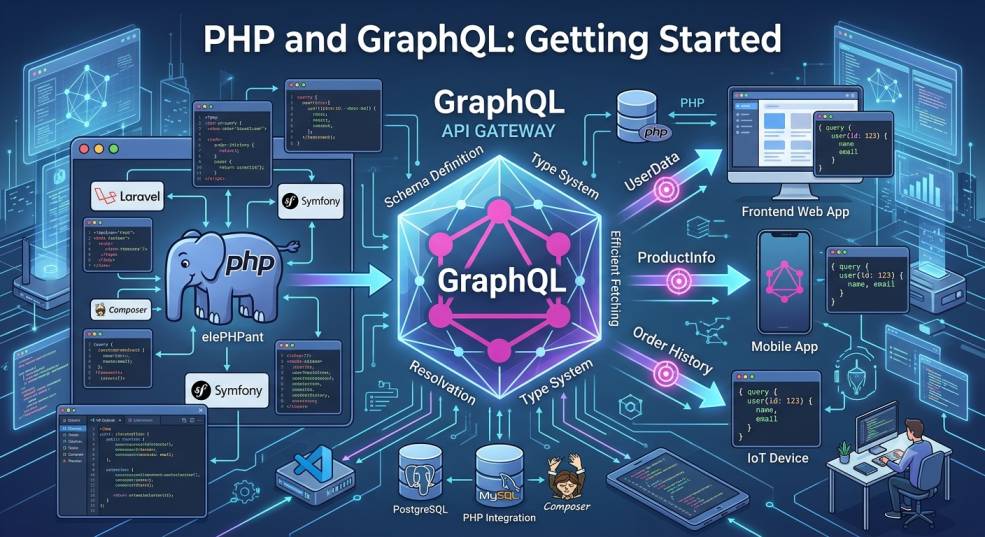
Modern applications demand flexible and customizable ways to access data. Traditional REST APIs often fall short when clients require precise control over what data is fetched. GraphQL, introduced by Facebook, addresses these limitations by allowing clients to query exactly the data they need — nothing more, nothing less.
While GraphQL is often linked to JavaScript ecosystems, PHP supports GraphQL very well, and several stable server libraries and framework integrations exist. This article explains how GraphQL works, how it differs from REST, and how to start building GraphQL-powered APIs in PHP — without using any code, focusing purely on concepts, architecture, and best practices.
What is GraphQL?
GraphQL is a query language for APIs that lets clients define what data they want to receive. Instead of multiple endpoints, a single GraphQL endpoint can serve many different types of data in a structured and efficient way.
Key Strengths
-
Precise Data Fetching — Avoids over-fetching and under-fetching common in REST.
-
Single Endpoint — All operations happen through a single request route.
-
Strong Typing — Schemas define data structure and ensure consistency.
-
Introspective — Clients can query available types and fields dynamically.
GraphQL vs REST
| Aspect | REST | GraphQL |
|---|---|---|
| Data Retrieval | Multiple endpoints | Single endpoint with flexible queries |
| Response Size | Often larger than needed | Exactly matches requested fields |
| Versioning | Requires new endpoints | Schema evolves while maintaining compatibility |
| Over-fetching | Common | Rare |
| Under-fetching | Common | Rare |
In short: GraphQL gives more control to the client and reduces network overhead.
Core GraphQL Concepts
1. Schema
A schema defines types and fields available to clients. It acts like a contract between client and server.
2. Queries
Clients send queries specifying the fields they need.
Example idea: request user + posts, without needing multiple endpoints.
3. Mutations
Used for write operations like create, update, delete.
4. Resolvers
Resolvers tell GraphQL how to fetch the requested data.
Every field has a resolver behind it (even if implicit).
5. Subscriptions
Support real-time data via websockets (optional but powerful).
Available GraphQL Server Libraries for PHP
| Library | Key Features | Use Case |
|---|---|---|
| webonyx/graphql-php | Low-level schema building, stable and mature | Custom GraphQL server implementation |
| Lighthouse (for Laravel) | Schema-first GraphQL server for Laravel | Laravel projects needing rapid GraphQL API development |
| API Platform (Symfony) | Automatic schema generation and GraphQL API | Symfony apps needing ready-made API ecosystem |
If you're using:
-
Laravel → Start with Lighthouse
-
Symfony → Use API Platform's GraphQL integration
-
Custom PHP app → Use webonyx/graphql-php
Architecture Overview
GraphQL in PHP typically fits into your app like this:
Data Sources May Include:
-
SQL Databases (MySQL, PostgreSQL, MariaDB)
-
NoSQL Databases (MongoDB, Redis)
-
External REST / SOAP APIs
-
Microservices
-
Filesystems or third-party services
GraphQL acts as a unified layer that abstracts data sources.
Schema Design Best Practices
-
Group fields by logical entities, not database tables.
-
Use meaningful names for queries and mutations.
-
Keep schemas small and composable.
-
Avoid deeply nested types where possible.
-
Remove internal implementation details from publicly exposed schemas.
The key is to design schemas based on product needs, not database structure.
Resolver Layer Strategies
A resolver can:
-
Call a service class
-
Fetch from database
-
Transform data into response format
Good Resolver Principles
-
Keep resolvers thin — call service layer instead of writing complex logic inside.
-
Avoid direct SQL queries in resolvers.
-
Use caching for repeated expensive lookups.
This keeps your architecture clean and maintainable.
Performance Considerations
N+1 Problem
GraphQL can trigger many repeated data calls (e.g., fetching each user’s posts individually).
Solution:
Use DataLoader-style batching to group related fetches.
Caching Strategies
-
Query caching: Cache results for common queries.
-
Field-level caching: Cache expensive resolvers separately.
-
Response caching: Good for anonymous public queries.
Pagination
Use cursor-based pagination to avoid massive offsets and load issues.
Security Practices
| Area | Recommendation |
|---|---|
| Authentication | Same session/JWT setup as REST |
| Authorization | Apply field-level & type-level access rules |
| Query Depth Limiting | Prevent deep, expensive queries |
| Query Cost Analysis | Assign cost to fields & reject costly queries |
GraphQL security requires restrictions, not just authentication.
When to Use GraphQL in PHP
Use GraphQL When:
-
The frontend needs flexible data access (SPA, mobile apps).
-
Multiple clients need different data shapes.
-
API endpoints are becoming too complex or numerous.
-
You need real-time updates (subscriptions).
Avoid GraphQL When:
-
Your application is extremely simple.
-
Only one type of client consumes the API.
-
Bandwidth and latency are not concerns.
-
You do not have time to manage schema governance.
Conclusion
GraphQL brings a highly structured, flexible and efficient approach to data querying compared to REST. In PHP ecosystems, libraries like webonyx, Lighthouse, and API Platform make it straightforward to adopt GraphQL whether you're using Laravel, Symfony, or custom architecture.
By focusing on schema design, clean resolver architecture, and efficient data loading, you can build fast, expressive, future-proof APIs that adapt to evolving product needs — all within your existing PHP stack.


