PHP & AI Chatbots: Connecting OpenAI APIs
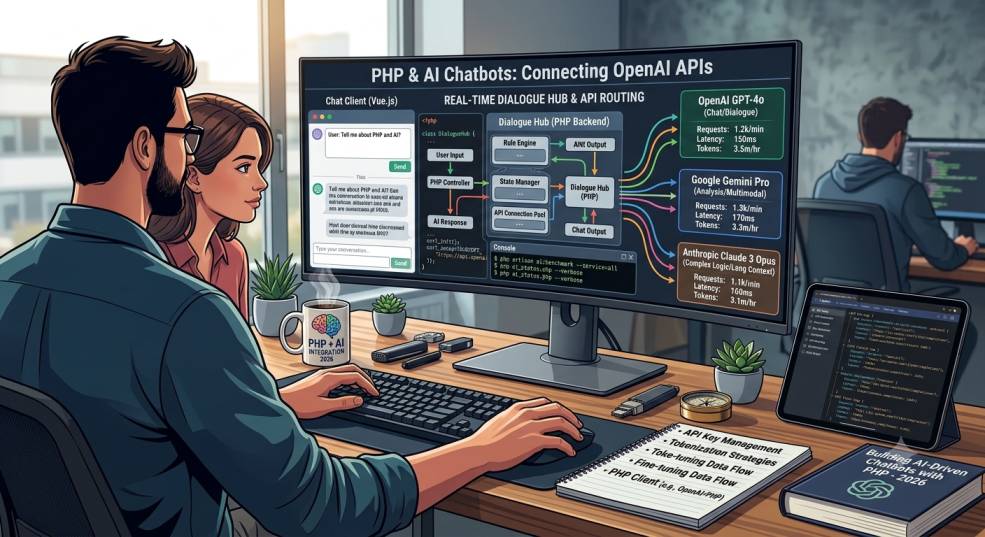
Artificial Intelligence (AI) has rapidly reshaped how businesses interact with customers. From automated help desks to intelligent assistants embedded inside apps, chatbots are becoming a necessity rather than an option. With advancements in natural language processing (NLP), chatbots are no longer limited to predefined responses; they can understand context, tone, intent, and deliver conversational experiences that feel human.
One of the most powerful tools enabling this shift is OpenAI, known for its GPT models that generate human-like responses. When combined with PHP, which remains one of the most widely used backend languages, developers can build scalable AI-powered chatbots for websites, CRMs, support systems, and enterprise workflows.
In this article, we’ll explore how to connect OpenAI APIs to PHP, how chatbots process information, and best practices for designing conversational user experiences.
Why Build Chatbots with OpenAI?
Before OpenAI-based models became accessible, chatbots relied mostly on:
-
Predefined rule-based decision trees
-
Manually written responses
-
Keyword detections
These chatbots were rigid, robotic, and often frustrating for users.
OpenAI-based chatbots solve these challenges:
| Feature | Traditional Chatbots | AI Chatbots (OpenAI) |
|---|---|---|
| Flexibility | Low | High |
| Language Understanding | Limited | Deep contextual understanding |
| Response Personalization | Hard to achieve | Built-in NLP |
| Multi-Language Support | Requires separate config | Automatic |
| Continuous Learning | Manual updates | Model-based general intelligence |
AI chatbots powered by GPT models can:
-
Understand intent, not just keywords
-
Respond naturally to conversational tone
-
Adjust messaging style dynamically
-
Handle complex multi-turn conversations
-
Work across different industries without retraining
Where PHP Fits in the Chatbot Workflow
PHP acts as the backend controller that:
-
Receives user input (via website chat UI or application interface)
-
Sends request to the OpenAI API
-
Receives AI-generated response
-
Applies business logic (if needed)
-
Returns final message to the user
This makes PHP an ideal backbone for:
-
Customer service chat widgets
-
CRM automation
-
Chat-based eCommerce assistance
-
Knowledge base search
-
Lead qualification bots
-
Appointment booking systems
How the OpenAI API Works
The OpenAI API accepts input text, processes it using a selected model, and returns a generated response.
Key elements include:
| Component | Purpose |
|---|---|
| API Key | Authentication credential |
Model (e.g., gpt-4.1-mini, gpt-4.1) | Determines intelligence level and cost |
| Prompt | User input or pre-structured instructions |
| Temperature | Controls creativity of response |
| Max Tokens | Controls output length |
Building the Chatbot Workflow
A typical chatbot process using PHP + OpenAI:
-
User sends message (e.g., “What is my order status?”)
-
PHP receives the text and sends a prompt to OpenAI API
-
OpenAI model interprets intent (customer wants order tracking)
-
PHP optionally connects to internal systems (database, CRM, ERP)
-
PHP formats the final reply and sends it back to user
This lets the chatbot act both as:
-
A conversational agent
-
And a business workflow assistant
Designing Conversation Prompts
The quality of chatbot responses depends heavily on the prompt strategy.
A good prompt structure includes:
System Message (Role & Behavior)
User Message (Actual user message)
Optional Context (Data retrieved from database)
Combining these helps the AI respond intelligently rather than guessing.
Personalization and Context Memory
To improve user experience, chatbots should:
-
Remember previous messages in a session
-
Understand conversation flow
-
Maintain emotional tone
This is achieved through conversation state tracking — typically stored in:
-
PHP sessions
-
Redis cache
-
Database chat history tables
Choosing the Right OpenAI Model
OpenAI provides multiple models, each suited to different tasks:
| Model | Best For | Characteristics |
|---|---|---|
gpt-4.1 | High-end conversational AI | Most accurate, best reasoning |
gpt-4.1-mini | Cost-efficient chatbot apps | Fast, affordable, still great quality |
gpt-o1 (reasoning model) | Advanced logic & math | Ideal for problem-solving assistance |
If your chatbot is customer service-focused, gpt-4.1-mini is usually ideal.
Security Considerations
When using OpenAI APIs:
-
Never expose API keys in frontend JavaScript
-
Always route calls through PHP backend
-
Implement rate limiting to avoid misuse
-
Filter harmful or illegal requests
-
Log and monitor abnormal usage patterns
Data privacy is especially important if your chatbot interacts with customer details.
Business Use Case Scenarios
1. Customer Support Automation
Chatbots respond instantly to common questions:
-
Shipping policies
-
Refund instructions
-
Product information
2. Sales Lead Qualification
Chatbots can gather:
-
Name
-
Contact details
-
Purchase intent
-
Budget
and forward qualified leads to CRM systems.
3. Appointment and Booking Bots
Connect chatbot to booking database and schedule appointments conversationally.
4. Internal Workflow Assistants
Employees can ask:
“Generate product description in friendly tone”
“Summarize weekly meeting notes”
Benefits of Using PHP with OpenAI
| Benefit | Explanation |
|---|---|
| Easy API Integration | Simple HTTP requests |
| Works with Web Apps | Ideal for chat widgets or support portals |
| Scalable | PHP servers can handle large request volumes |
| Cost-Efficient | No need to train AI models manually |
Future Possibilities
As AI models evolve, chatbots will gain:
-
Emotional intelligence capabilities
-
Voice interface features
-
Real-time multilingual translation
-
Autonomous decision-making logic
With PHP as a stable backend layer, upgrading to new AI models becomes frictionless.
Conclusion
Integrating OpenAI APIs with PHP enables developers to build powerful, conversational chatbots that deliver natural human-like interactions. By structuring conversation flows, managing user context, and securing API communication, PHP turns into a robust bridge between AI intelligence and real-world applications.
Whether you’re developing support bots, sales helpers, or internal productivity assistants — PHP combined with OpenAI offers flexibility, scalability, and performance to meet modern business needs.


