PHP 9: What’s New and What to Expect
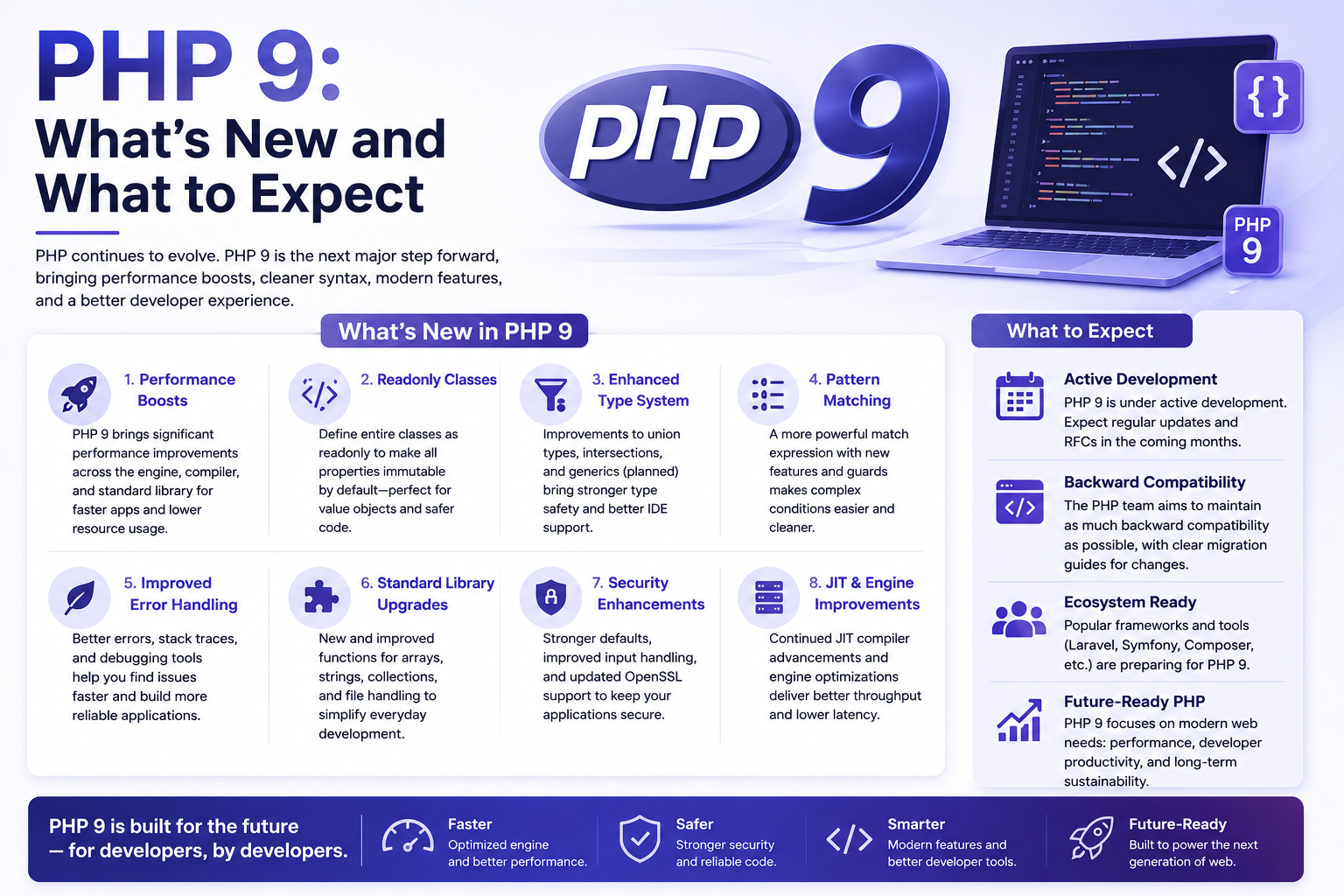
The upcoming release of PHP 9 marks a significant shift in the evolution of one of the web’s most widely used programming languages. While version 8 has already brought many enhancements, PHP 9 is poised to focus on stricter typing, cleaner syntax, more consistent behaviours and removal of long-standing legacy quirks. In this article we’ll explore the key changes developers and teams should anticipate, why these matter, and how you can begin preparing your codebase now.
Why PHP 9 Matters
PHP continues to power a large portion of web applications, from content management systems to APIs and microservices. As the language matures, the need to modernise becomes more urgent: outdated behaviours, implicit type conversions and legacy features create maintenance burdens and subtle bugs. PHP 9 aims to address many of these issues by moving toward a more predictable, robust and developer-friendly foundation. This is not simply about new features—it’s about enforcing better practices and setting a clearer path for future development.
Key Features and Enhancements
Improved Increment / Decrement Behavior
One of the surprising sources of inconsistency in previous PHP versions has been operator behaviours like ++ and -- when applied to strings, booleans or empty values. PHP 9 will clarify and tighten those rules. As detailed in community previews: string increments such as
that previously yielded unexpected results will instead throw a TypeError.
Beyond strings, behaviour for booleans and null values will align more strictly with numeric context. These improvements reduce surprise behaviours, making debugging and maintenance easier.
Stricter Error Handling for unserialisation
Serialization and unserialisation remain common patterns in PHP—but historically they have been a source of silent warnings rather than exceptions. With PHP 9, calls to unserialize() that fail will raise an UnserializationFailedException rather than a non-fatal warning.
This change makes error handling more explicit and helps avoid cases where silent failures lead to corrupted state or hidden bugs.
Simplified Function Signatures and Cleaner APIs
In PHP 9 the language core will simplify certain function/method signatures and separate overloaded functions into more focused variants. For example, rather than one function serving multiple roles, you may see dedicated functions that have a single responsibility.
This design decision helps improve readability, reduce cognitive load and make the codebase easier to maintain long-term.
No More Arrays from False Values (Autovivification Removal)
One of PHP’s quirky behaviours has been autovivification: the ability to treat false as an array and have it automatically converted. In PHP 9, this will no longer be allowed—attempting to append to a false value will trigger an error.
By eliminating this kind of automatic conversion, PHP encourages developers to treat data types more explicitly and avoid subtle bugs in dynamic contexts.
Simplified String Interpolation
String interpolation in PHP has supported multiple syntaxes, including ${variable} and complex expressions inside strings. In PHP 9 the older forms will be deprecated or removed in favour of simpler, clearer syntax: e.g. use "$name" or {$name} rather than ${name}.
This change improves consistency and readability, especially for new developers or mixed teams.
Warnings Promoted to Errors
Certain patterns that were previously non-fatal warnings will be elevated to errors in PHP 9. Examples include access to undefined variables or properties. The goal: detect bugs earlier and force cleaner code.
While this may require more careful coding, it ultimately leads to more stable applications and fewer runtime surprises.
Removal of Deprecated Features
Over recent PHP versions (8.1, 8.2, 8.3, 8.4) many features were flagged as deprecated. PHP 9 plans to remove several of them entirely. Developers who have ignored deprecation warnings will face breaking changes unless they update.
Key areas could include legacy constructors, deprecated functions or extensions, and older language constructs. Treat this as an opportunity to clean up legacy code and adopt modern best practices.
Enhanced Type System and Future Capabilities
Although still under discussion, PHP 9 is anticipated to bring improvements around type safety: intersection types, perhaps improved generics support, and better static analysis.
These enhancements align PHP with more strongly typed languages while maintaining its flexibility and ease of use.
Release Timeline and Current Status
At present, there is no official release date for PHP 9.0. The PHP development team appears to be focusing on incremental versions such as PHP 8.5 or 8.6 first.
Because development has not yet fully begun for PHP 9, early previews and RFCs are still the primary source of information. Developers should monitor RFC submissions, join discussions, and test when snapshots become available.
How to Prepare Your Codebase
Audit and Fix Deprecation Warnings
Begin with your existing application: run static analysis, enable E_ALL error reporting, and fix any deprecation warnings from PHP 8.x. This will ease the transition to PHP 9 when it arrives.
Adopt Stricter Typing and Better Error Handling
Take advantage of type hints, strict_types, and exception-based error handling now. These habits will align your code with the upcoming PHP 9 behaviour and reduce surprise breakages.
Review Legacy Features and Remove Dependence
Identify old constructors, deprecated extensions/functions, implicit behaviours like autovivification, and update or remove them. Modern frameworks and libraries typically already support PHP 8+; ensure your stack is compatible.
Monitor RFCs and Test Early
Keep an eye on official PHP RFCs and milestone announcements. When alpha or beta builds become available, test your apps early in development or staging — catching compatibility issues now is far easier than in production.
Update Hosting and Infrastructure
Your hosting environment may need to support new PHP builds, dependencies and tooling. Verify that your CI/CD, deployment scripts, and container images are ready for changes in PHP runtime behaviour.
Why this Upgrade Matters for Businesses and Teams
For organisations, PHP 9 offers several strategic advantages:
-
Improved reliability: stricter errors and fewer silent failures mean fewer runtime surprises.
-
Cleaner codebase: simplifying functions, removing legacy behaviours and reducing implicit conversions improves maintainability.
-
Future-ready architecture: by aligning with tighter typing, modern APIs and cloud-native patterns, you position apps for growth and scalability.
-
Talent alignment: modernising the stack makes hiring and onboarding easier, as newer developers expect clearer syntax and stricter patterns.
In short, upgrading proactively gives you competitive advantage, better code hygiene and lowers long-term maintenance cost.
Conclusion
PHP 9 represents a major inflection point for the language: moving from an era of flexibility and implicit behaviours to one of clarity, predictability and modern best practices. While not all features are finalised and the release date remains open, the changes already previewed are significant: improved operator behaviour, stricter error handling, removal of legacy quirks, simpler APIs and a stronger type system.
For developers and organisations alike, preparation begins now. Auditing code, addressing deprecations, adopting stricter patterns and familiarising with upcoming changes will smooth the transition. In doing so you’ll not only be ready for PHP 9 — you’ll be well positioned for cleaner, more maintainable and future-proof PHP applications.


