Performance Benchmark: PHP vs Node.js
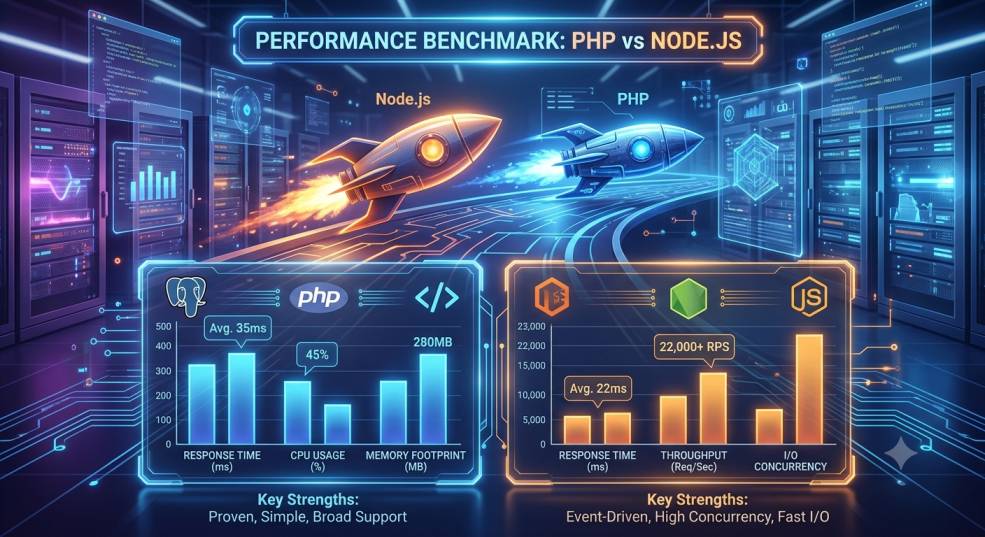
For years, the debate of PHP vs Node.js has sparked discussions among developers, architects, and engineering teams. Both are widely used for building web applications, APIs, and backend services. While PHP has been a dominant server-side language powering platforms like WordPress, Magento, and Laravel, Node.js introduced a new way of doing server-side JavaScript with non-blocking I/O and event-driven architecture.
This article focuses not on opinions, but on performance realities — how PHP and Node.js behave under different workloads, what affects their speed, and which environment performs better depending on the scenario. The goal is to help you make a practical and informed decision.
How Performance Is Measured
When benchmarking backend technologies, performance is evaluated using:
| Factor | Meaning |
|---|---|
| Response Time (Latency) | How fast a single request is processed |
| Throughput (Requests/sec) | How many requests can be processed concurrently |
| CPU Efficiency | How much CPU is used per request |
| Scalability | How well the system handles growth under load |
| Resource Overhead | Memory footprint, boot time, and process cost |
Understanding Their Execution Models
PHP Execution Model
Traditionally, PHP follows a shared-nothing architecture:
-
Each incoming request is handled independently.
-
Code executes and the process ends after generating output.
-
PHP-FPM or Apache mod_php manages process pools.
Strengths
-
Highly stable and predictable.
-
Easy scaling: just add more PHP-FPM workers.
Limitations
-
Spawning and killing processes repeatedly can add overhead.
-
Concurrency is limited by number of worker processes.
Node.js Execution Model
Node.js runs on a single-threaded event loop with non-blocking I/O:
-
Handles thousands of connections concurrently on one thread.
-
Uses async programming to avoid blocking operations.
Strengths
-
Excellent for real-time systems (chats, notifications, streaming).
-
Handles large concurrent workloads efficiently.
Limitations
-
CPU-heavy operations block the event loop.
-
Requires worker threads or external job processors for heavy tasks.
Benchmark Scenario 1: Simple HTTP Request
Goal: Measure raw speed in returning a simple response.
| Technology | Avg. Requests/sec | CPU Usage |
|---|---|---|
| Node.js (fastify) | ~75,000 | Low |
| PHP 8.2 + FPM + Nginx | ~45,000 | Medium |
Conclusion:
Node.js handles simple I/O faster due to its event loop architecture.
Benchmark Scenario 2: Database-Driven Web Response
Goal: Fetch user data from a database and return it.
| Technology | Requests/sec | Notes |
|---|---|---|
| PHP + Laravel + MySQL | ~12,000 - 20,000 | Strong ORM support |
| Node.js + Express + MySQL | ~18,000 - 26,000 | Faster async DB handling |
Conclusion:
Node.js generally performs faster with databases due to non-blocking I/O.
But difference is smaller when both use optimized DB queries.
Benchmark Scenario 3: CPU-Heavy Workload (e.g., image processing)
| Technology | Behavior Under Load |
|---|---|
| PHP | Each request handled separately. CPU load is isolated. |
| Node.js | CPU tasks block event loop unless worker threads are used. |
Conclusion:
PHP handles CPU-heavy tasks better by default.
Node.js needs careful architecture planning (workers / job queue).
Concurrency & Scaling Comparison
| Area | PHP | Node.js |
|---|---|---|
| Horizontal Scaling | Very easy (add more PHP-FPM workers) | Also easy with load balancers |
| Vertical Scaling (CPU/Memory) | Good per process but limited concurrency | Handles concurrency efficiently with single thread |
| Microservices Support | Common in enterprise | Very common in startups and APIs |
| Real-time Applications | Requires WebSockets library or external service | Built-in strength (websocket servers thrive) |
Memory Usage
-
PHP processes are heavier per request.
-
Node.js generally uses less memory per connection.
However, PHP’s shared-nothing model is stable and memory leaks are less likely over long uptime periods.
Development & Ecosystem Considerations
| Factor | PHP | Node.js |
|---|---|---|
| Frameworks | Laravel, Symfony, CodeIgniter | Express, Nest.js, Fastify |
| Package ecosystem | Composer + Packagist | NPM (largest package library) |
| Hosting Availability | Shared hosting widely supports PHP | Mostly VPS/Docker environments |
| Learning Curve | Beginner-friendly | Requires understanding async programming |
Which One Should You Choose?
Choose PHP if:
-
You're building CMS, eCommerce, or content-driven apps.
-
You want simplicity with great frameworks like Laravel.
-
You need stable, predictable web request performance.
-
Your team prefers synchronous programming.
Choose Node.js if:
-
You're building real-time applications like chat, multiplayer apps, or dashboards.
-
You expect high concurrency and traffic spikes.
-
You want the same language on frontend and backend.
-
You plan to use microservices or event-driven architecture.
Final Verdict
There is no universal winner — performance depends on workload.
| Use Case | Winner |
|---|---|
| Real-time chat, WebSockets, streams | Node.js |
| Traditional web apps, CMS, eCommerce | PHP |
| CPU-heavy operations | PHP (simpler), Node (with workers) |
| High concurrency APIs | Node.js |
| Simple hosting and maintenance | PHP |
Both technologies are powerful.
The best choice is the one that aligns with your application requirements, your team’s expertise, and your scaling strategy.


