Multi-tenant Architecture in PHP
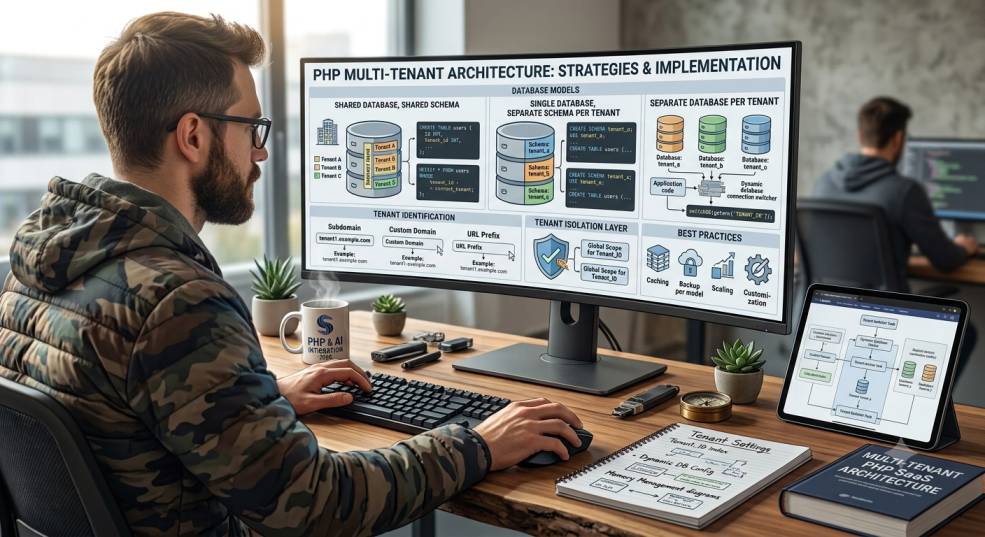
The demand for SaaS (Software as a Service) solutions has grown rapidly as businesses increasingly rely on cloud-based software instead of self-hosted applications. To support multiple customers efficiently while reducing operational costs, developers often design systems based on multi-tenant architecture.
In simple terms, multi-tenant architecture means one application instance serves multiple customers, known as tenants. However, each tenant must feel as though they have their own isolated system — their data should remain private, secure, and independent from others.
This blog explains how to build multi-tenant architecture in PHP, exploring models, database strategies, routing, scaling, and best practices for building SaaS applications.
What is Multi-Tenant Architecture?
In a multi-tenant environment, multiple clients (organizations, companies, teams, or users) use the same application, while each tenant has:
-
Unique users
-
Custom settings
-
Separate or isolated data
Tenants may share the application code, but their data must remain separated and protected.
This differs from single-tenant architecture, where each customer receives a completely separate application.
Why Build a Multi-Tenant System?
| Benefit | Explanation |
|---|---|
| Lower Infrastructure Costs | Multiple tenants share the same app and server, reducing hosting expenses. |
| Simplified Maintenance | Updates and bug fixes are applied once and become available for all tenants. |
| Scalability | Easier to add new tenants without deploying new app instances. |
| Consistent Performance | Efficient resource sharing improves operational stability. |
Multi-tenancy is ideal for SaaS platforms like CRM systems, inventory systems, HR tools, and collaboration apps.
Multi-Tenant Architecture Models
There are three main database models used in multi-tenant PHP applications:
1. Single Database, Shared Tables
All tenants share:
-
One database
-
The same tables
-
Tenant data identified by a tenant ID column
Pros:
-
Cheapest to host
-
Simple schema maintenance
-
Easy scaling
Cons:
-
Requires strict data isolation logic
-
Risk of data leakage if queries are not handled carefully
2. Single Database, Separate Tables Per Tenant
All tenants use:
-
One database
-
A set of tables duplicated per tenant (e.g., orders_tenant1, orders_tenant2)
Pros:
-
Stronger data separation
-
Good balance of cost and security
Cons:
-
Database grows quickly in size
-
Harder to manage migrations
3. Separate Database Per Tenant
Each tenant has:
-
Their own isolated database
-
Shared application code
Pros:
-
Highest security and data isolation
-
Easy data backup and export per tenant
Cons:
-
More expensive
-
Requires automation for database provisioning
Tenant Identification Strategies
The system must detect which tenant is making the request. Common tenant identification methods include:
| Method | Example | Use Case |
|---|---|---|
| Subdomain | tenant1.example.com | Most common and scalable |
| Domain Mapping | customdomain.com → tenant | Allows branding per client |
| URL Path Prefix | example.com/tenant1/ | Simple but less elegant |
| Session / Auth Metadata | Based on logged-in user tenant info | Useful for internal systems |
Subdomain-based routing is the most widely used in SaaS systems.
Handling Authentication in Multi-Tenant Systems
Each tenant has its own:
-
Users
-
Roles
-
Permissions
User accounts must always be linked to the correct tenant. This prevents users from accessing data from other tenants, even if authentication is valid.
Data Isolation & Security
Security is one of the biggest challenges in multi-tenant systems. Best practices include:
-
Always filter database queries by tenant ID
-
Prevent cross-tenant access at both application and database levels
-
Restrict administrative tools to tenant-specific context
-
Log and track tenant-level user activity separately
-
Encrypt sensitive data where necessary
Security is non-negotiable in multi-tenant software.
Configuration & Customization
Each tenant may require different:
-
Feature sets
-
Branding and UI themes
-
Permissions
-
Billing tiers
A flexible configuration layer ensures:
-
Easy feature toggling
-
Support for plan upgrades
-
Seamless tenant onboarding
Multi-tenant applications often use role-based access control to differentiate permissions.
Scaling Multi-Tenant Applications
As tenants grow, performance must remain stable. Scaling strategies include:
| Strategy | Description |
|---|---|
| Load Balancers | Distribute requests across multiple servers |
| Horizontal Scaling | Add more servers instead of upgrading one |
| Caching | Reduce database calls using Redis or Memcached |
| Read-Replica Databases | Offload reporting queries to replicas |
| Queue Workers | Move heavy tasks to background jobs |
Scalability planning should begin early to avoid performance bottlenecks.
Backups and Disaster Recovery
Backup strategies depend on your database model.
-
Shared database → full database backups
-
Separate database per tenant → backup per tenant
Maintain:
-
Automated daily backups
-
Versioned backups for recovery
-
Tenant restore workflows
Disaster recovery plans ensure minimal downtime during failures.
Monitoring and Observability
To maintain performance:
-
Track tenant-level resource usage
-
Log errors per tenant
-
Set alerts for slow queries or high server load
This prevents one tenant from overwhelming shared resources.
When NOT to Use Multi-Tenant Architecture
Avoid multi-tenancy when:
-
Tenants need heavily custom workflows or business logic
-
Compliance requires completely isolated environments
-
A tenant expects full database ownership or offline deployment
In such cases, single-tenant may be the correct choice.
Conclusion
Multi-tenant architecture allows PHP applications to efficiently support multiple customers while optimizing cost, maintainability, and scalability. Choosing the right database model, implementing robust security practices, designing flexible configuration layers, and planning for scalability are key to building a successful multi-tenant SaaS platform.
As SaaS adoption grows, multi-tenancy becomes an essential architectural pattern. With thoughtful planning and implementation, PHP can power secure, scalable, and reliable multi-tenant systems capable of serving thousands of users under a single unified application.


