Laravel and Serverless Deployment
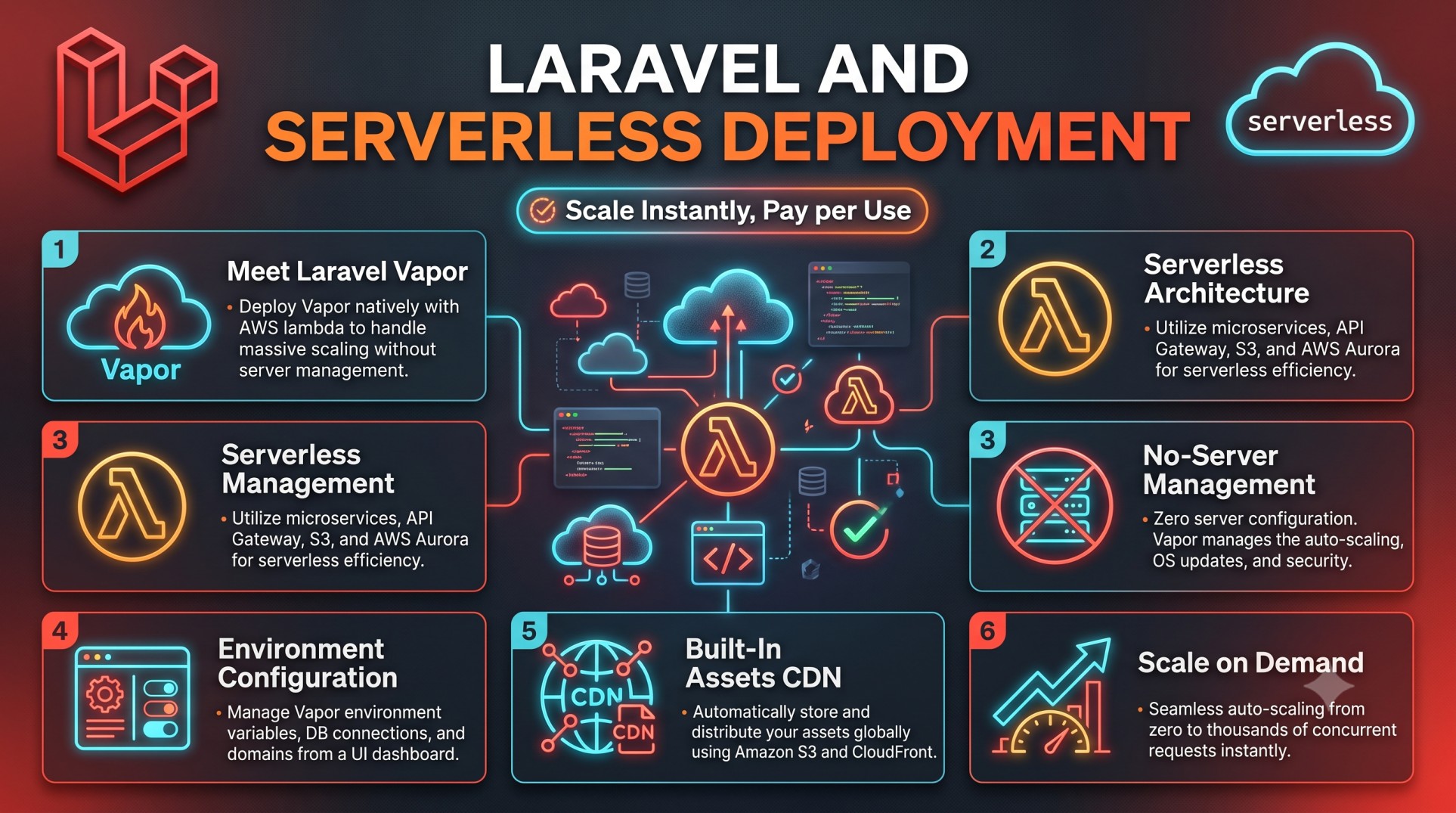
As web applications continue to grow in complexity and global reach, developers are constantly seeking more scalable, cost-effective, and maintenance-free deployment solutions. Enter serverless computing — a cloud-based model that eliminates the need for managing traditional servers while automatically scaling your application on demand.
Laravel, one of the most popular PHP frameworks, has traditionally thrived in environments like shared hosting or virtual private servers. But as technology evolves, serverless deployment for Laravel has become not only possible but also incredibly powerful.
In this post, we’ll explore what serverless deployment means for Laravel, why developers are adopting it, the benefits and challenges involved, and the best practices to make your Laravel applications run seamlessly in a serverless environment.
What Is Serverless Deployment?
The term “serverless” doesn’t mean there are no servers — it simply means that the developer doesn’t manage them. The cloud provider (such as AWS, Google Cloud, or Azure) automatically provisions and scales resources based on traffic.
Serverless architectures are typically built around Function as a Service (FaaS), where each function is event-driven and executed independently. Instead of keeping servers running 24/7, your code runs only when triggered — for example, by a user request, file upload, or scheduled event.
The result? You only pay for what you use, and scaling happens automatically without manual intervention.
For Laravel developers, this is a huge shift — one that brings both exciting opportunities and new technical considerations.
Why Consider Serverless for Laravel?
Laravel is known for its expressive syntax, powerful routing, ORM, and Blade templating. However, running Laravel on a traditional web server means maintaining a persistent environment — managing PHP-FPM, Nginx configurations, caching layers, and scaling manually.
Serverless deployment removes that burden. Instead, your Laravel app runs as isolated, stateless functions that scale instantly based on traffic load.
Here are some compelling reasons to adopt serverless for Laravel:
-
Automatic Scaling: No need to configure autoscaling groups or load balancers — the cloud provider handles it.
-
Reduced Costs: You pay only for the execution time of your functions. Idle time costs nothing.
-
Zero Server Maintenance: No patching, updating, or monitoring infrastructure.
-
High Availability: Serverless platforms are inherently distributed, improving reliability.
-
Faster Deployments: Serverless tools simplify continuous integration and deployment workflows.
-
Environment Flexibility: You can combine Laravel’s backend power with other serverless services like queues, storage, and authentication.
This approach aligns perfectly with modern, event-driven architectures — especially for microservices or APIs.
How Laravel Fits in a Serverless World
At its core, Laravel is a full-stack framework that expects a long-running PHP process. Serverless platforms, however, operate on short-lived stateless functions. Bridging this gap requires careful optimization and adaptation.
Over the years, tools like Laravel Vapor, Bref, and Vercel adapters have emerged to make this integration smooth and production-ready. These tools package Laravel so it can run efficiently within environments like AWS Lambda or Google Cloud Functions.
Let’s look at some of these popular options:
1. Laravel Vapor (Official Serverless Platform)
Laravel Vapor is Laravel’s official serverless deployment platform, built specifically for AWS. Developed by Taylor Otwell (the creator of Laravel), Vapor abstracts away all the complex AWS configurations and provides a simple dashboard for deploying, scaling, and managing Laravel applications in a serverless way.
Key features include:
-
AWS Lambda-powered runtime for your Laravel app.
-
Automatic scaling based on demand.
-
Integrated caching, queues, and databases.
-
Zero-downtime deployments.
-
Automatic SSL, environment variables, and assets management.
Vapor makes deploying Laravel serverlessly as simple as pushing your app to a Git repository — ideal for teams that want serverless benefits without deep AWS expertise.
2. Bref (Open Source Alternative)
Bref is an open-source project that brings serverless PHP support to AWS Lambda. It works by creating a lightweight PHP runtime compatible with AWS’s serverless infrastructure.
With Bref, you can run not just Laravel but also other PHP frameworks and microservices in a serverless environment. It’s more hands-on than Vapor but gives developers full control over their AWS configuration.
Bref is great for developers who:
-
Prefer an open-source ecosystem.
-
Want to experiment with custom runtime configurations.
-
Need more control over AWS resources.
While it requires more setup than Vapor, it offers the same scalability and cost efficiency.
3. Vercel and Netlify for Laravel Frontends
For Laravel applications that use Inertia.js or Next.js for frontends, serverless platforms like Vercel and Netlify can host parts of the app — especially frontend logic and API endpoints — as edge functions.
This hybrid approach (Laravel backend + serverless frontend) improves global performance and reduces backend load.
Benefits of Serverless Laravel Deployment
-
Unmatched Scalability:
Serverless automatically scales to meet demand — from one request per day to thousands per second. -
Cost Optimization:
You only pay for active execution time, making it perfect for applications with variable traffic. -
Simplified DevOps:
No need for complex infrastructure management, freeing developers to focus on coding features. -
Improved Global Reach:
Serverless functions can run in multiple regions, reducing latency for users worldwide. -
Energy Efficiency:
Running only when needed reduces idle server usage, aligning with sustainable development practices.
Challenges in Serverless Laravel Deployment
While serverless offers incredible advantages, it also introduces new challenges that developers must plan for:
-
Cold Starts:
When a function hasn’t been invoked recently, serverless platforms may take longer to “warm up” — increasing response time. Tools like Vapor’s prewarming feature help mitigate this. -
Stateless Environment:
Since serverless functions don’t persist state between requests, sessions and file uploads must rely on external storage (like Amazon S3 or Redis). -
Execution Time Limits:
AWS Lambda and other platforms impose time limits per request (often 15 minutes). Long-running processes may need to move to queues or background jobs. -
Vendor Lock-In:
Using platform-specific services (like Vapor on AWS) can make it harder to switch providers later. -
Learning Curve:
Developers must learn cloud concepts such as IAM permissions, Lambda layers, and storage configurations.
Despite these, the benefits typically outweigh the drawbacks — especially for scalable applications.
Best Practices for Laravel Serverless Deployment
To make the most of Laravel’s serverless potential, follow these proven best practices:
-
Optimize Boot Time:
Minimize package bloat and autoload dependencies. Use Laravel’s caching features (config:cache,route:cache) to speed up function cold starts. -
Use Queues for Heavy Tasks:
Offload long-running operations (like sending emails or processing files) to Laravel Queues, which integrate perfectly with serverless workers. -
Store Everything Externally:
Use cloud storage (e.g., S3) for files and Redis or DynamoDB for session data. -
Monitor Performance:
Use AWS CloudWatch, Laravel Telescope, or third-party tools for error tracking and performance insights. -
Optimize Database Connections:
Use persistent database proxies (like RDS Proxy) to avoid connection overhead. -
Automate Deployment:
Use CI/CD tools (GitHub Actions, Vapor CI, Bitbucket Pipelines) to streamline deployments. -
Design for Statelessness:
Think in terms of functions and events — each request should be independent.
Following these principles ensures your Laravel application remains robust, performant, and scalable in a serverless world.
Use Cases for Serverless Laravel
Serverless Laravel isn’t a one-size-fits-all solution, but it shines in specific scenarios:
-
APIs and Microservices: Lightweight APIs that scale independently.
-
E-commerce: Handling sudden traffic spikes during sales.
-
SaaS Platforms: Multi-tenant systems with variable usage patterns.
-
Job Processing: Offloading asynchronous workloads like notifications or imports.
-
Content-driven Sites: Applications where traffic fluctuates based on campaigns or events.
If your Laravel project fits one of these categories, serverless is a strong candidate.
Future of Laravel in the Serverless Era
The shift toward serverless architecture reflects a broader evolution in web development — one where scalability, automation, and developer productivity take center stage.
Laravel’s ecosystem continues to evolve with this trend. The introduction of Vapor, broader PHP support in AWS, and the growing demand for edge computing make Laravel a first-class citizen in the serverless world.
Looking ahead, we can expect tighter integrations with edge functions, real-time data streaming, and hybrid cloud deployments — all of which make Laravel more powerful and adaptable than ever before.
Conclusion
Serverless deployment marks a new chapter in Laravel’s evolution — one that empowers developers to build scalable, efficient, and cost-effective applications without worrying about server management.
Whether you choose Laravel Vapor for its simplicity or Bref for its flexibility, moving Laravel to a serverless platform can drastically improve performance, reduce costs, and simplify DevOps workflows.
By embracing best practices — optimizing boot times, using queues, and designing for statelessness — developers can unlock the full potential of Laravel in the cloud era.
In the end, Laravel and serverless deployment aren’t just compatible — they’re the perfect match for a future where code, scalability, and performance converge seamlessly.


