How to Use PHP for IoT Applications
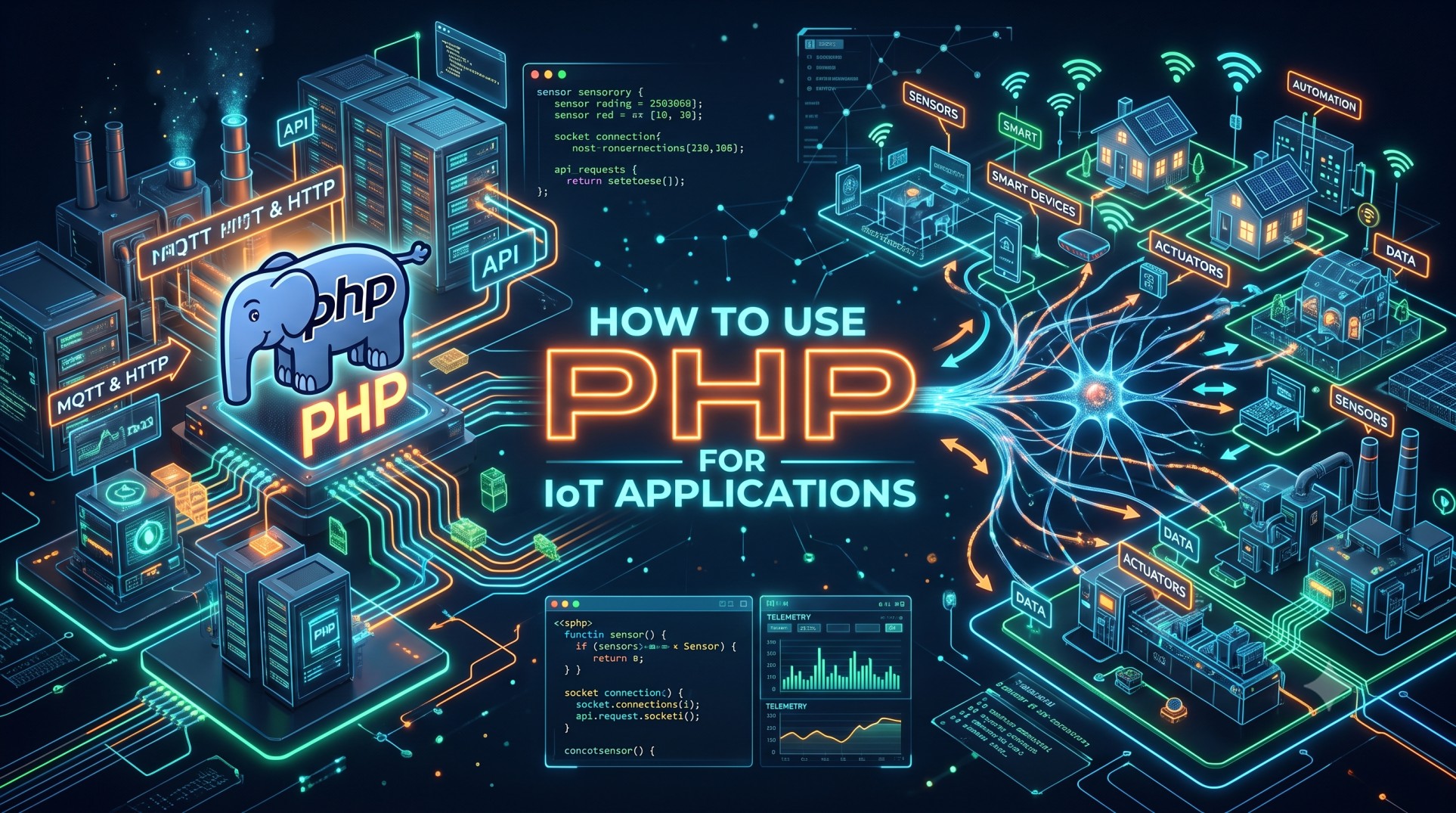
The Internet of Things (IoT) has revolutionized the way devices communicate and interact. From smart homes to industrial automation, IoT solutions are everywhere. While languages like Python and C are commonly associated with IoT development, PHP — the web’s most enduring language — can also play a key role in building scalable IoT systems. With PHP’s flexibility, web-readiness, and server integration, it can act as a powerful backend for IoT communication, data collection, and visualization.
In this blog, we’ll explore how PHP can be effectively used for IoT applications, the tools and frameworks that make it possible, and best practices for integrating IoT devices with PHP-based systems.
Why Use PHP for IoT?
Although PHP isn’t typically the first choice for IoT hardware programming, it shines in data management, API communication, and real-time web dashboards — all essential parts of an IoT ecosystem. Here’s why PHP remains relevant:
1. Mature and Web-Friendly
PHP’s long history in powering the web means it’s naturally suited for handling HTTP requests, JSON, and RESTful APIs — which are crucial for IoT communication.
2. Excellent Database Integration
IoT devices generate tons of data. PHP integrates effortlessly with MySQL, PostgreSQL, MongoDB, and Redis, allowing you to store, analyze, and visualize IoT metrics in real time.
3. Easy to Deploy and Scale
Using PHP with frameworks like Laravel or Slim allows developers to quickly deploy cloud-based IoT data collectors and dashboards. Pair this with tools like Docker and Kubernetes, and you get a scalable infrastructure.
4. Compatibility with MQTT and WebSockets
PHP supports MQTT (Message Queuing Telemetry Transport) via libraries such as phpMQTT or Mosquitto-PHP, enabling efficient communication with IoT devices. It can also handle WebSockets for real-time updates between servers and clients.
PHP’s Role in the IoT Architecture
To understand how PHP fits into IoT systems, let’s look at the typical architecture.
1. IoT Devices (Edge Layer)
These are physical sensors and microcontrollers (like Raspberry Pi, Arduino, ESP8266) that collect data and send it to a server. They usually communicate via HTTP, MQTT, or WebSocket protocols.
2. Communication Layer
Here, PHP acts as a middleware — handling data ingestion, authenticating devices, and pushing data into storage systems. APIs written in PHP can process incoming sensor data and trigger alerts or responses.
3. Data Processing Layer
PHP applications can work alongside message brokers like RabbitMQ or Kafka, processing real-time data streams. Although heavy computations are better handled by Python or Node.js, PHP is excellent for routing and managing processed data.
4. Visualization and Control Layer
This is where PHP truly shines — creating dashboards and control panels for IoT users. You can use Laravel, Symfony, or even WordPress to build rich user interfaces that show live data, trends, and device statuses.
Building a Simple PHP-Based IoT Application
Let’s imagine an IoT system for temperature monitoring in smart homes.
-
Devices: A Raspberry Pi collects temperature and humidity data via a DHT11 sensor.
-
Communication: The Pi sends JSON data (e.g.,
{temperature: 28, humidity: 65}) to a PHP API endpoint every few seconds. -
PHP API: A PHP script receives the data, validates it, and stores it in a MySQL database.
-
Dashboard: A Laravel or plain PHP dashboard displays temperature graphs, sends alerts when limits are exceeded, and provides logs.
Example Workflow (Conceptually)
-
The IoT device sends data using HTTP POST to
https://example.com/api/sensor-data. -
PHP reads the payload, sanitizes it, and saves it in the database.
-
The user dashboard fetches real-time readings via AJAX or WebSockets.
This architecture makes PHP the data hub for IoT, without requiring direct control over hardware.
PHP Libraries and Tools for IoT Development
Several PHP libraries make IoT integration straightforward:
1. phpMQTT
A lightweight PHP MQTT client that allows IoT devices and servers to publish or subscribe to topics.
2. Ratchet
A PHP library for building WebSocket servers, ideal for pushing real-time IoT updates to dashboards.
3. Laravel Echo & Pusher
When using Laravel, Laravel Echo combined with Pusher or Socket.IO enables live event broadcasting — perfect for displaying instant IoT data updates.
4. ReactPHP
A non-blocking event-driven PHP framework that’s useful for asynchronous I/O operations, making PHP behave like Node.js for real-time data handling.
5. Mosquitto-PHP
Bindings for the Mosquitto MQTT library that let PHP apps directly communicate with MQTT brokers.
Best Practices for Using PHP in IoT Projects
To ensure performance, scalability, and security, follow these practices when integrating PHP with IoT systems:
1. Secure Device Authentication
Each IoT device should have a unique API key or token. Avoid open endpoints that can receive arbitrary data. Use HTTPS for all communication.
2. Use Message Brokers for Scalability
Instead of sending every message directly to your PHP API, use a message queue like RabbitMQ or MQTT. PHP can consume data from the broker asynchronously.
3. Cache Frequently Accessed Data
IoT systems often need live data retrieval. Use Redis or Memcached to cache recent readings and reduce database load.
4. Optimize PHP Performance
Enable OPcache, use PHP-FPM, and ensure your application runs on PHP 8.3+ to take advantage of the latest speed and memory improvements.
5. Handle Large Data Streams Efficiently
Batch data inserts into databases rather than inserting each reading individually. Use background jobs (via Laravel Queues or Supervisor) for heavy operations.
6. Visualize Data Effectively
PHP’s strength lies in web interfaces. Integrate with charting libraries like Chart.js or Highcharts to create intuitive dashboards.
Real-World Examples of PHP in IoT
Several real-world solutions already use PHP in IoT contexts:
-
Smart Agriculture: PHP backends collect data from soil sensors and weather stations to manage irrigation.
-
Home Automation Systems: PHP APIs handle communication between mobile apps and devices such as lights, cameras, and thermostats.
-
Industrial Monitoring: Factories use PHP dashboards to monitor equipment performance and receive alerts when metrics go out of range.
These applications highlight PHP’s versatility beyond web development — as a control center for connected devices.
Challenges and How to Overcome Them
While PHP works well in IoT ecosystems, it has limitations:
1. Not Designed for Embedded Systems
PHP doesn’t run directly on microcontrollers like C or MicroPython. Solution: Use PHP for the server side while devices run lightweight firmware.
2. Concurrency Handling
Traditional PHP execution is synchronous. Solution: Use ReactPHP or Swoole for asynchronous processing.
3. Data Volume and Latency
Handling millions of IoT messages can overwhelm servers. Solution: Offload message ingestion to brokers or streaming systems and use PHP for analytics and APIs.
Future of PHP in IoT
As PHP continues to evolve with improved async capabilities and performance boosts in PHP 8.3 and beyond, it’s becoming more suitable for handling modern workloads. The rise of Edge Computing and Serverless PHP (via platforms like Bref on AWS Lambda) makes PHP even more powerful in IoT environments. Developers can build lightweight APIs, deploy them serverlessly, and handle IoT data efficiently.
Conclusion
PHP might not control sensors directly, but it’s the glue that connects devices, stores data, and provides meaningful interfaces. From receiving IoT signals to visualizing real-time analytics, PHP offers everything needed for a robust, scalable IoT backend. By combining modern PHP tools, frameworks, and practices, developers can confidently build efficient IoT ecosystems that balance performance, security, and scalability.
Whether you’re building a smart home dashboard or managing thousands of industrial sensors, PHP proves that it’s not just for websites — it’s a powerful engine for the connected world.


