Event-Driven Architecture with PHP
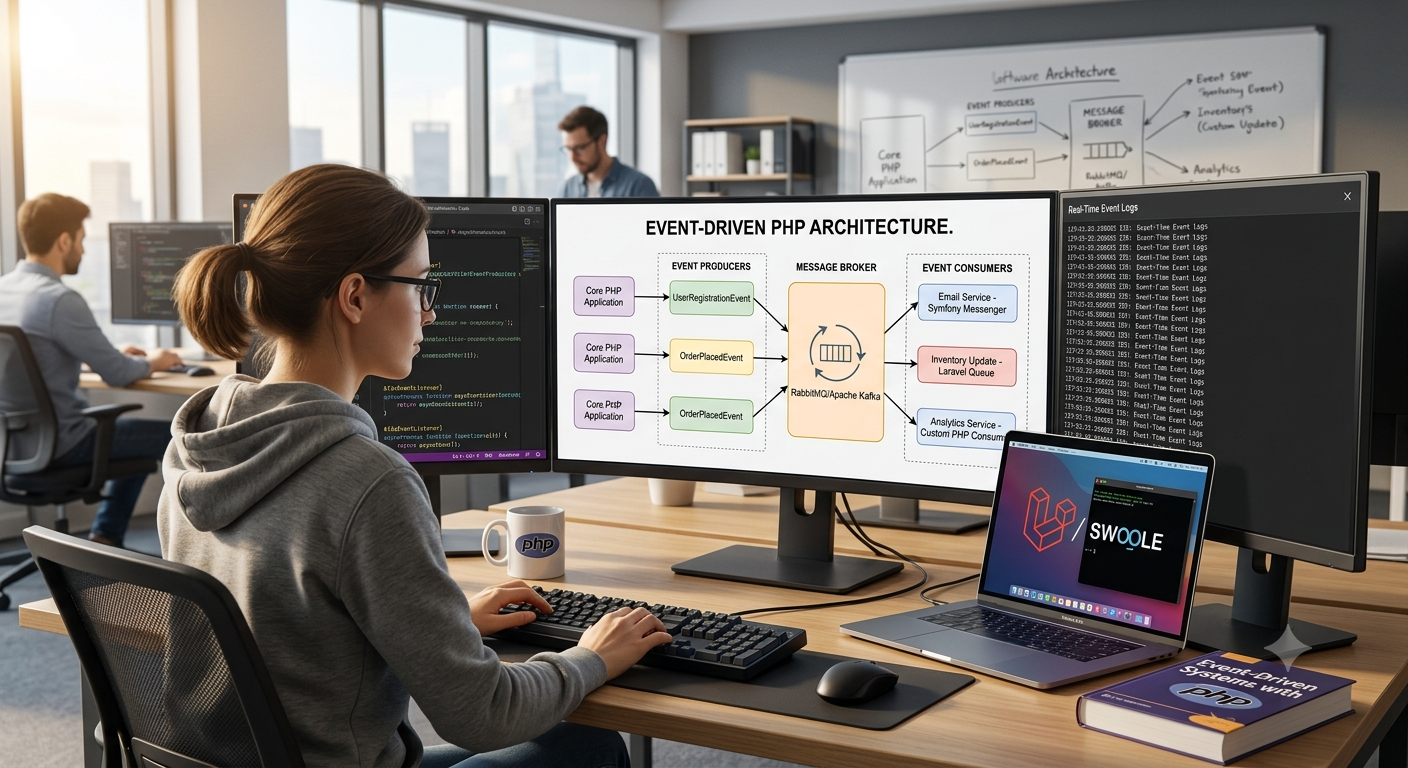
As applications grow in complexity, traditional tightly coupled architectures can become difficult to maintain, scale, and extend. Modern software systems often need to react to many events happening across different services or components — such as new user registrations, file uploads, payment confirmations, or notifications. This is where Event-Driven Architecture (EDA) comes in.
Event-Driven Architecture allows applications to communicate through the production, detection, and consumption of events. Instead of services calling each other directly, they respond to events as they happen, making systems more flexible and efficient.
PHP, known for powering a large percentage of the web, is fully capable of implementing event-driven systems. With powerful frameworks and modern messaging tools, PHP applications can leverage EDA to enhance performance and scalability.
What is Event-Driven Architecture?
Event-Driven Architecture is a software design pattern where components of an application communicate by sending and responding to events rather than making direct requests.
An event is simply a change in state.
Examples:
-
A user creates an account
-
A payment is completed
-
A file is uploaded
-
A product is ordered
Instead of tightly linking systems, events let different parts of the application react independently.
Key Components of Event-Driven Architecture
| Component | Description |
|---|---|
| Event Producers | Components that generate or trigger events. (Example: User registration triggers a “UserRegistered” event.) |
| Event Consumers | Components that listen for and act on events. (Example: Send welcome email when “UserRegistered” event occurs.) |
| Event Bus / Message Broker | A communication layer that delivers events from producers to consumers. (Example: Redis, RabbitMQ, Kafka.) |
This separation ensures that producers don’t need to know which consumers exist, making each part of the system loosely coupled.
Why Use Event-Driven Architecture in PHP?
1. Scalability
Components operate independently, so you can scale only the parts that need more resources. For example, if email sending is heavy, you can run more email workers without touching the rest of your system.
2. Loose Coupling
The system becomes more modular. Changing one feature does not affect others, reducing development risk.
3. Better Performance
Tasks that don’t need immediate completion (e.g., sending confirmation emails) can run asynchronously, improving response time.
4. Flexibility for Future Changes
You can easily add new features by subscribing new consumers to an existing event — no need to modify the core logic.
How Event-Driven Architecture Fits Within PHP Applications
Traditionally, PHP applications are request-driven — they run only when called by HTTP requests. But modern applications often use:
-
Message brokers to queue events
-
Background worker processes
-
WebSockets for real-time updates
-
Microservices interacting through events
Frameworks like Laravel, Symfony, and tools like RabbitMQ, Redis Streams, and Kafka make event-driven development in PHP straightforward.
Typical Workflow in an Event-Driven PHP Application
-
Something happens in the application.
Example: A customer places an order. -
The application triggers an event:
OrderPlaced. -
The event is sent to an event bus/message queue.
-
Multiple consumers listen for this event:
-
One service updates inventory
-
Another generates an invoice
-
Another sends an email confirmation
-
Each consumer processes the event independently, without affecting the others.
Real-World Use Cases of Event-Driven Architecture in PHP
1. E-commerce Systems
When an order is placed, multiple tasks occur:
-
Reduce stock
-
Notify warehouse
-
Send receipt
-
Update CRM
Event-driven design separates these tasks, improving reliability.
2. Notification and Messaging Services
Websites often send SMS, Emails, Push Notifications. EDA allows notifications to be processed in the background, improving response time.
3. Logging and Analytics
Events like “PageViewed” or “ProductClicked” can be stored and processed later — ideal for dashboards and tracking systems.
4. Microservices Communication
EDA allows independent PHP services to talk without direct API calls.
Benefits of Using an Event Bus or Message Queue
A queue ensures events are not lost and can be processed later if the system is busy.
Popular message brokers used in PHP systems include:
-
RabbitMQ
-
Redis Streams
-
Apache Kafka
-
Amazon SQS
These tools allow asynchronous, resilient processing.
Challenges and Considerations
1. Complexity
EDA introduces more moving parts — queues, workers, logs — so monitoring and tooling are important.
2. Event Duplication
Consumers must be designed to handle repeated events gracefully.
3. Debugging
Tracing event flows across systems can be harder than debugging direct calls.
Using centralized logging and distributed tracing helps.
Best Practices for Implementing EDA in PHP
| Best Practice | Explanation |
|---|---|
| Name events clearly | Use meaningful event names (e.g., UserRegistered). |
| Keep events immutable | Once triggered, the event data shouldn’t change. |
| Make consumers idempotent | Ensure processing the same event twice does not cause errors. |
| Use monitoring tools | Track queue backlogs, worker failures, and performance. |
| Document event flows | Clear diagrams help maintain and extend the system. |
Conclusion
Event-Driven Architecture offers a powerful way to design scalable, decoupled, and efficient PHP applications. By structuring your application around events rather than direct calls, you gain flexibility, responsiveness, and maintainability.
Whether you’re building an e-commerce system, notification service, analytics pipeline, or microservice platform, EDA provides a modern approach to managing complexity in PHP applications.
As the digital world continues to demand real-time interactions and high scalability, mastering Event-Driven Architecture with PHP is a valuable skill for developers and companies alike.


