Building Scalable APIs with PHP and Slim Framework
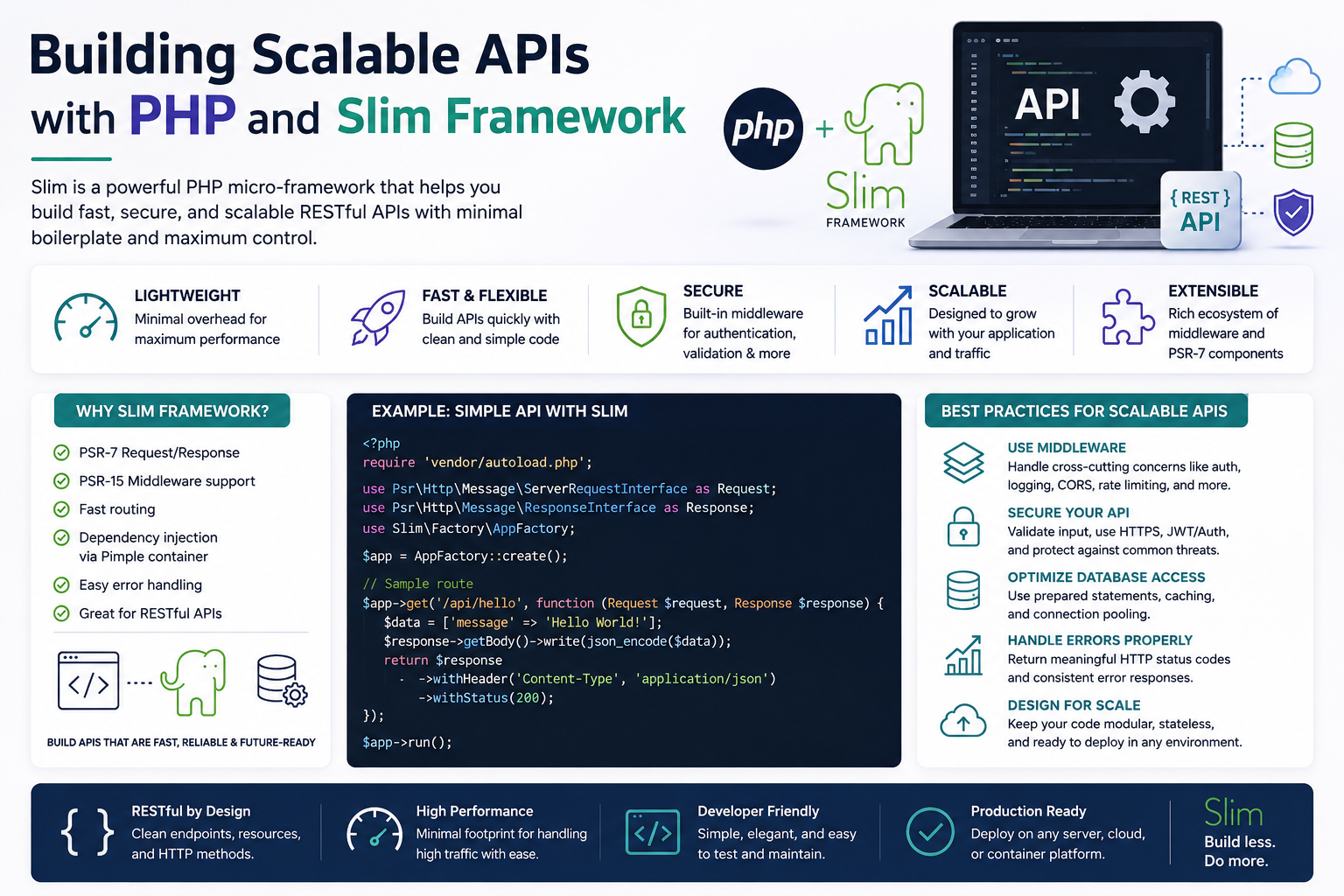
In the evolving world of web development, building scalable APIs has become essential for modern applications. Businesses today rely heavily on microservices and lightweight APIs to power mobile apps, single-page web applications, and cloud-based platforms. While several technologies compete for dominance, PHP continues to stand strong—especially when paired with frameworks like Slim, which make API development clean, fast, and efficient.
This blog will explore how to build scalable, maintainable APIs using PHP and the Slim Framework, why Slim is ideal for this purpose, and best practices that ensure your APIs can grow seamlessly as your project expands.
Why Choose PHP for API Development
PHP remains one of the most widely used server-side languages because of its simplicity, versatility, and massive ecosystem. While newer technologies such as Node.js or Go have gained popularity, PHP continues to offer compelling advantages for API development.
Mature Ecosystem and Tools
PHP’s ecosystem includes a wide array of libraries, frameworks, and tools that simplify development. Composer, the PHP package manager, allows developers to easily install and manage dependencies, making it easy to integrate authentication, logging, and caching.
High Performance with Modern Versions
With the release of PHP 8 and beyond, performance has dramatically improved. JIT (Just-In-Time) compilation, strict typing, and optimized memory handling have made PHP a strong competitor for backend systems that need scalability.
Easy Hosting and Deployment
PHP applications can be deployed across a variety of hosting environments — from traditional shared hosting to Docker containers and cloud platforms like AWS or Google Cloud. This flexibility makes PHP an excellent choice for scalable API architectures.
Introducing the Slim Framework
The Slim Framework is a lightweight micro-framework built for PHP developers who need simple yet powerful tools to create APIs and web services. It follows the micro-framework philosophy, meaning it provides just the essentials — routing, middleware, and dependency injection — while leaving you free to choose your preferred components for databases, templating, and authentication.
Key Features of Slim
-
Minimal Core: Only what’s necessary for handling requests and responses.
-
PSR Compliance: Fully adheres to modern PHP-FIG standards like PSR-7 and PSR-15.
-
Middleware Support: Easy integration of authentication, caching, and CORS handling.
-
Dependency Injection (DI): Simplifies managing external classes and services.
-
Extensible: Compatible with libraries like Eloquent ORM or Monolog.
Setting Up a Slim Framework Project
Setting up a Slim-based API is straightforward. You can start with just a few terminal commands.
Step 1: Install via Composer
This creates a basic project structure with preconfigured routes, dependencies, and a simple example controller.
Step 2: Configure Your Environment
Inside the .env file (or settings.php), define your environment variables such as database credentials, API keys, and debug mode. Slim’s container-based setup allows you to manage these configurations centrally.
Step 3: Define Your First Route
Open src/routes.php and add a simple route:
This simple route demonstrates Slim’s power — concise syntax and clean code that handles routing efficiently.
Structuring APIs for Scalability
A scalable API is one that can handle increasing traffic, features, and integrations without major refactoring. Here’s how to structure your Slim application for growth.
Use Controllers and Services
Instead of placing all logic inside routes, separate concerns:
-
Controllers handle HTTP requests and responses.
-
Services manage business logic.
-
Models interact with the database.
For example:
Implement Dependency Injection
Slim’s container (based on Pimple) allows you to define services like database connections and loggers once and use them throughout your app.
Use Middleware for Common Tasks
Middleware is perfect for implementing features like authentication, logging, and request validation.
Connecting Slim with Databases
While Slim doesn’t include a database layer, it integrates easily with popular ORMs.
Using Eloquent ORM
Eloquent, from Laravel, works beautifully with Slim:
Set up your connection:
Now you can define models like this:
Adding Authentication and Authorization
JWT Authentication
For APIs, JWT (JSON Web Tokens) provide secure, stateless authentication. Slim allows easy integration of JWT middleware.
Configure it:
Now, protected routes will only respond to requests with a valid JWT token.
Role-Based Access Control (RBAC)
You can add middleware to check user roles before executing certain routes. This helps enforce permissions without cluttering controller code.
Optimizing API Performance
Use Caching
Implement caching layers using tools like Redis or Memcached to store frequently requested data. This reduces database load and speeds up responses.
Pagination and Filtering
For large datasets, implement pagination (limit and offset) and filtering options in your routes to prevent unnecessary data transfer.
Asynchronous Processing
For background tasks (like sending emails or processing reports), consider using queues such as RabbitMQ or Laravel Horizon connected via CLI scripts or webhooks.
Ensuring Scalability
Containerization
Use Docker to package your Slim app along with its dependencies. This ensures consistency across environments and allows for easy scaling using orchestration tools like Kubernetes.
Horizontal Scaling
Slim applications can scale horizontally by running multiple instances behind a load balancer. PHP-FPM and Nginx combinations work well for this.
Database Scaling
As your data grows, consider read replicas and sharding to handle increased database load efficiently.
API Documentation and Testing
Documentation with OpenAPI (Swagger)
Use the OpenAPI Specification to generate automatic API documentation. Tools like swagger-php or Redoc can scan annotations from your controllers and build interactive documentation.
Automated Testing
Use PHPUnit for unit and integration tests. Testing helps prevent regressions as your API evolves.
You can write tests for endpoints to ensure consistent output:
SEO and Developer Experience
While APIs don’t directly affect traditional SEO, developer-focused SEO still matters. Ensure your API documentation, blogs, and developer guides are well-optimized with relevant keywords like PHP API, Slim Framework, REST API, and scalable architecture.
Good documentation and intuitive endpoints improve developer experience (DX) — a key part of SEO in developer communities and marketplaces.
Conclusion
Building scalable APIs with PHP and Slim Framework is both efficient and future-proof. Slim offers a lightweight foundation that lets you design high-performance APIs with flexibility and simplicity. Combined with PHP’s maturity, ecosystem, and modern enhancements, developers can create reliable backends capable of handling enterprise-level traffic.
By adopting best practices like proper architecture, dependency injection, caching, and containerization, you ensure your Slim-based APIs are ready for long-term scalability.
Whether you’re building a startup API or an enterprise service, Slim Framework with PHP delivers a perfect balance of speed, simplicity, and scalability — proving that PHP continues to be a powerful choice for API-driven web applications in 2025 and beyond.


